
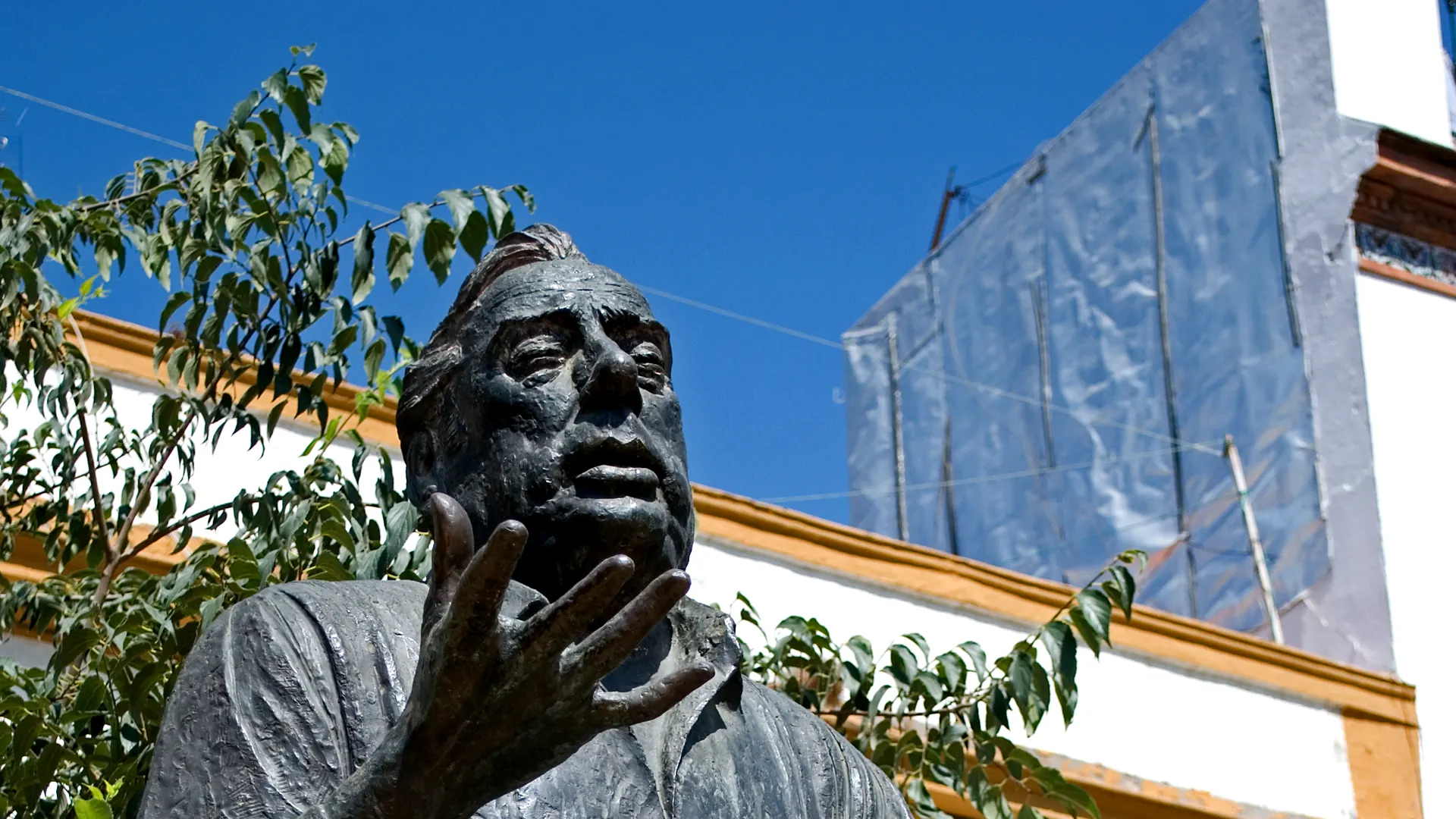
In the Alameda de Hércules, in Seville, there is a bronze statue with its face lifted and one hand on its chin, in the exact gesture of a man listening to something inside himself before he starts to sing. It stands a few steps from the tenement yard where the man it portrays was born. Two more statues share the boulevard: Pastora Pavón, la Niña de los Peines, and the bullfighter Chicuelo. The three of them knew each other, and all three were from that neighbourhood.
His name was Manuel Ortega Juárez, and depending on who you ask he became either the greatest cantaor of the century or the man who very nearly ruined flamenco. Hardly ever both at once. That contradiction is his story.
Four generations of cante on a Seville street
He was born in the corral del Fraile, at number 10 of calle Lumbreras, in the heart of the Alameda district, on 7 July 1909. (Reliable sources also give the 9th; both dates circulate and neither can be treated as settled.) His father, Manuel Ortega Fernández, was a semi-professional cantaor and sword-boy to his cousin, the bullfighter Joselito el Gallo. His mother was Dolores Juárez Soto.
He did not choose the nickname; he inherited it. His father was known as Caracol el del Bulto, so the boy became el Niño de Caracol to tell them apart. The cantaor himself told the story behind it: as a child, his father threw a ball at a pot of snails —caracoles— that was cooking in the kitchen of his aunt Gabriela Ortega, mother of the Gallo bullfighting dynasty, and the name came out of the row that followed. It is a family story and it has the variants family stories have; the pot is in all of them.
Behind him lay a lineage nobody could invent. On his mother’s side he descended from El Planeta, the first cantaor recorded by name in flamenco history, and his relatives included Curro Dulce, Enrique Ortega el Gordo and the dancers Rita and Carlota Ortega. It carried on after him too: all four of his children —Luisa, Enrique, Lola and Manuela— worked in the art, and the singer Manzanita was his nephew.
Granada, 1922: a twelve-year-old among the prize-winners
On 13 and 14 June 1922, in the plaza de los Aljibes of the Alhambra, Manuel de Falla, Federico García Lorca and Ignacio Zuloaga staged the Concurso de Cante Jondo in Granada, a contest meant to rescue an art they believed was dying and therefore restricted to amateurs: nobody who made a living from singing could enter. The jury was chaired by Antonio Chacón and included la Niña de los Peines and the guitarist Andrés Segovia.
A twelve-year-old boy entered, one who had already been singing in the taverns of his neighbourhood for some time. He sang seguiriyas and saetas and came away with a prize. The jury left the Premio de Honor unawarded and gave the Premio Zuloaga to Diego Bermúdez, el Tenazas, a seventy-two-year-old cantaor from Morón, long retired, who is said to have walked much of the way there.
Exactly what the boy was given is one of the things that is not settled: some sources speak of a shared first prize, the Alhambra trust holds that the two of them won it, and the Andalusian Flamenco Institute puts it at a special mention from the jury. What is firm is that the Zuloaga went to el Tenazas and that Manuel Ortega was among those awarded. Whatever the paperwork said, forty years later it hung on the wall of his own tablao in Madrid.
From the ópera flamenca to Madrid
The Granada prize put him in circulation: theatres in Seville, tours, touring companies. These were the years of the ópera flamenca, the bullring-and-big-theatre format that filled venues with fandangos and light songs and left the deep cante for the very end, when the hall had half emptied. Caracol moved through that world from childhood and never felt the contempt for it that others did.
In 1930 he married Luisa Gómez Junquera, from Jerez, at the parish church of San Lorenzo in Seville, and made his first record. In 1935 he moved to Madrid, where he earned his living exactly as he had in Seville: singing at private parties. The Spanish Civil War put an end to those, and he turned to the theatre instead. Once the war was over he put together a show with Pepe Pinto and la Niña de los Peines that mixed cante, dance and theatre over an orchestra or a piano. That was where his real career began.
Zambra: flamenco with a piano and an orchestra
The word zambra came from Granada, from the gypsy parties in the caves of the Sacromonte. Caracol took it into the theatre and turned it into something else: a flamenco number sung over a piano —played by his son-in-law Arturo Pavón— and over a full orchestra, with lyrics by professional songwriters and proper stage design.
Today it sounds harmless. At the time it was a provocation. Flamenco was sung with one guitar, one chair and nothing else, and putting a string section behind a seguiriya was, for a large part of the audience, taking it out of its place. He did it anyway, and he did it well: nobody argues that what he made was flamenco, they argue about whether it should have been made. You can hear what it sounded like: on ALL FLAMENCO, Juan Fariña sings one of his zambras accompanied on the piano — six minutes, free to watch.
Lola Flores, eight years
In 1943 the impresario Adolfo Arenaza built a show called Zambra around a twenty-year-old dancer from Jerez, Lola Flores, and hired Caracol to sing alongside her. He resented the billing —his name in smaller type— and took the job for the money. They opened in Valencia at the end of that year and reached Madrid on 18 February 1944, at the Teatro de la Zarzuela.
It became the biggest theatrical success of post-war Spain. The lyrics were by Quintero, León and Quiroga, the sets by the painter José Caballero, and out of it came La niña de fuego and La Zarzamora. The show ran, with changes, for close to eight years, and along the way the two of them made two films together: Embrujo (1947) and La niña de la venta (1951).
The relationship was romantic as well as professional, and it was public, even though he was married and fourteen years older. Lola described it later without softening anything: “We lived a violent, marvellous life. Nights of wine and singing. We were the gods of the small hours.” They separated in 1951, on stage and off it, and each became enormous separately — she, above all, on her way to becoming La Faraona.
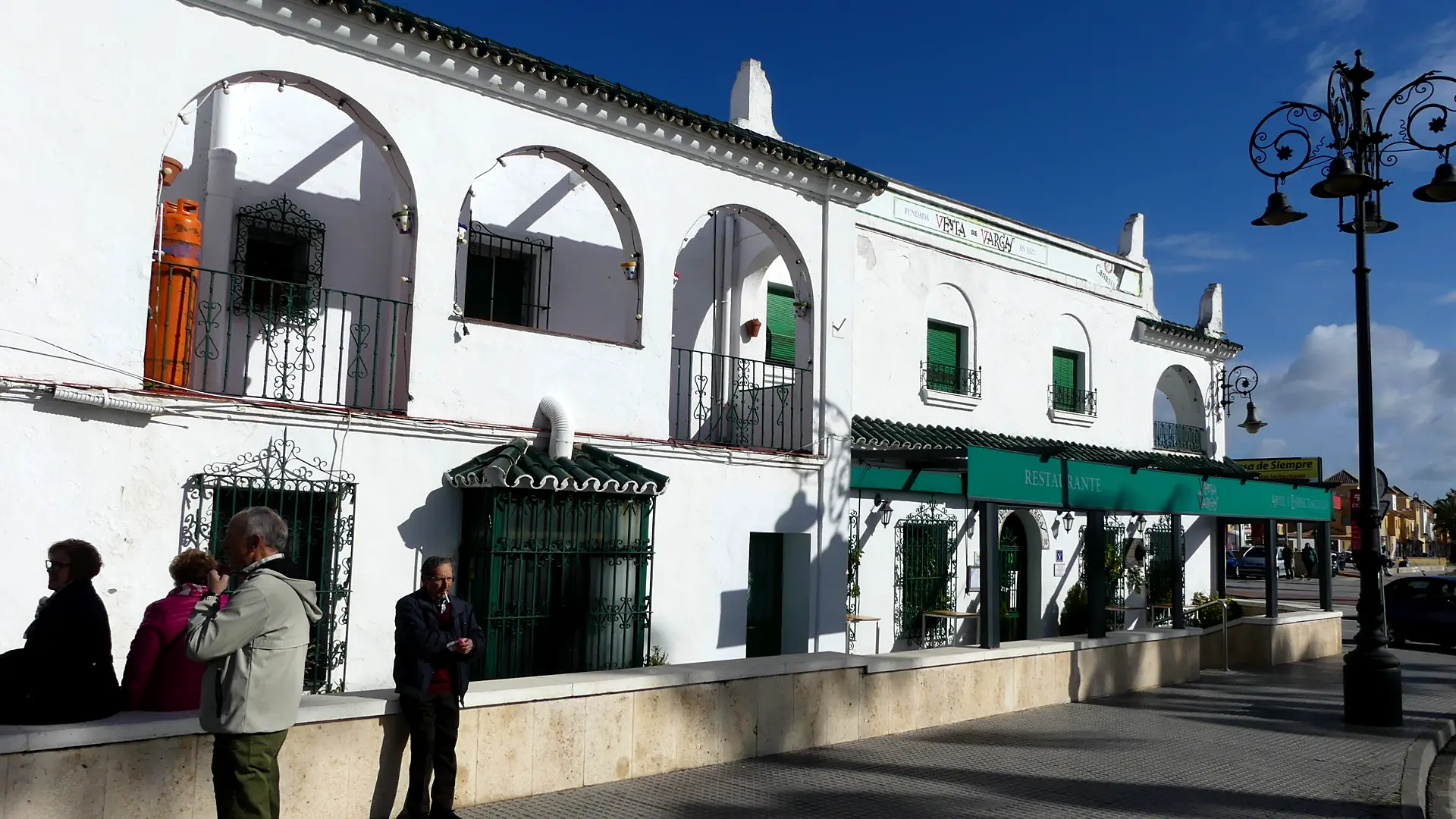
One scene from those years is still told in Andalucía. When Catalina Pérez died — the owner of the Venta de Vargas in San Fernando, the roadside inn where Camarón grew up as an artist — Caracol leaned out of the balcony and sang seguiriyas as her coffin passed below. ALL FLAMENCO has that moment staged inside «Venta de Vargas. Musical Flamenco»: the number is called «Muerte de Catalina».
Una historia del cante flamenco, 1958
Anyone who thinks he was only a showman needs one record. In 1958 he cut a double album, Una historia del cante flamenco, with Melchor de Marchena on guitar, directed by the musicologist Manuel García Matos, professor at the Madrid Conservatory: twenty-four cantes tracing the history of the genre, with seguiriyas, saetas and malagueñas sung without a single concession.
His most quoted line comes from the same place, and it sums up his idea of the job: cante is not shouting and it is not for the deaf; it has to be made “caricia jonda, pellizco chico” — a deep caress, a small pinch. (The line circulates in two different wordings and no dated interview pins it down; the documentary trail points to this anthology.) Which is, put another way, the opposite of what he was accused of: for him the depth lay in singing half under his breath.
Los Canasteros, “the royal opera house of the gypsies”
On 1 March 1963 he opened his own tablao at number 10 of calle Barbieri in Madrid, a stone’s throw from the Gran Vía: Los Canasteros. The Duchess of Alba christened it “the royal opera house of the gypsies” and the name stuck. Pastora Imperio, la Niña de los Peines, Imperio Argentina and a young Rocío Jurado all passed through, and the all-night parties were talked about across Madrid. What became of Los Canasteros is a story of its own: it closed for good in 1993.
Caracol against Mairena
You cannot tell Caracol’s story without Antonio Mairena, and it is no coincidence that both were born in 1909. They were the two poles of the flamenco of their century. Mairena researched, wrote, arranged cante into a genealogy and founded a school —mairenismo— on one fixed idea: there is a correct way to perform each cante, and it consists of not touching it. Caracol founded nothing, wrote no book and set out to conserve nothing. He sang what he felt like singing, with a piano if a piano was what it needed.
The quarrel was not only about taste. It was about territory. Mairena took ownership of the festivals, which in the 1960s were becoming the prestigious circuit, while Caracol took ownership of the tablaos, which were becoming the disreputable one. The split had very concrete consequences: Caracol stopped being invited to the festivals.
The episode that captures it best is El Planeta. Caracol always said that the first documented cantaor in flamenco history was his great-great-grandfather on his mother’s side. Mairena and his co-author Ricardo Molina doubted it all their lives, and almost everyone doubted it with them. In 2011, Manuel Bohórquez’s genealogical research followed the parish records —Cádiz, Málaga, Seville— and proved that El Planeta, Antonio Monge Rivero, really was his great-great-grandfather. Caracol had been right and nobody believed him. It took eighty years to establish, and by then he had been dead for thirty-eight.
BIO
Name and birth
Manuel Ortega Juárez, “Manolo Caracol”.
Seville, corral del Fraile, calle Lumbreras 10, 7 July 1909. Some sources give the 9th.
He started out as el Niño de Caracol, to tell him apart from his father.
Family
Parents: Manuel Ortega Fernández, Caracol el del Bulto, cantaor and sword-boy to Joselito el Gallo, and Dolores Juárez Soto.
Wife: Luisa Gómez Junquera, married in 1930.
Four children: Luisa, Enrique, Lola and Manuela, all four of them performers.
On his mother’s side, great-great-grandson of El Planeta.
Milestones
1922: first prize, shared with el Tenazas, at the Concurso de Cante Jondo in Granada.
1943: Zambra opens, with Lola Flores.
1958: Una historia del cante flamenco, with Melchor de Marchena.
1963: opens the tablao Los Canasteros, in Madrid.
1972: his last record.
Death
Madrid, 24 February 1973, in a car crash. He was sixty-three.
The last journey
It was a Saturday. He left his house at kilometre 15 of the Coruña road heading for Los Canasteros, in his car and with his driver. The wind was fierce. At kilometre 9.7, near the Puente de los Franceses, the car went into a post. He died instantly, on 24 February 1973, at sixty-three, on his way to work at his own tablao. On the record he had made the year before he had left a farewell fandango.
Half a century on, the argument about whether any of it was orthodox has lost most of its interest, and what remains is the material: the monograph the Andalusian Flamenco Institute devoted to him, the records, and a body of work that keeps being reclaimed every time somebody plays it again. Caracol left no school because he never wanted one. He left a way of singing that is recognisable within three bars and that nobody has managed to imitate — which, in the end, amounts to the same thing the other way round.
Header image: statue of Manolo Caracol in the Alameda de Hércules, Seville. Photo: Anual · CC BY 3.0