
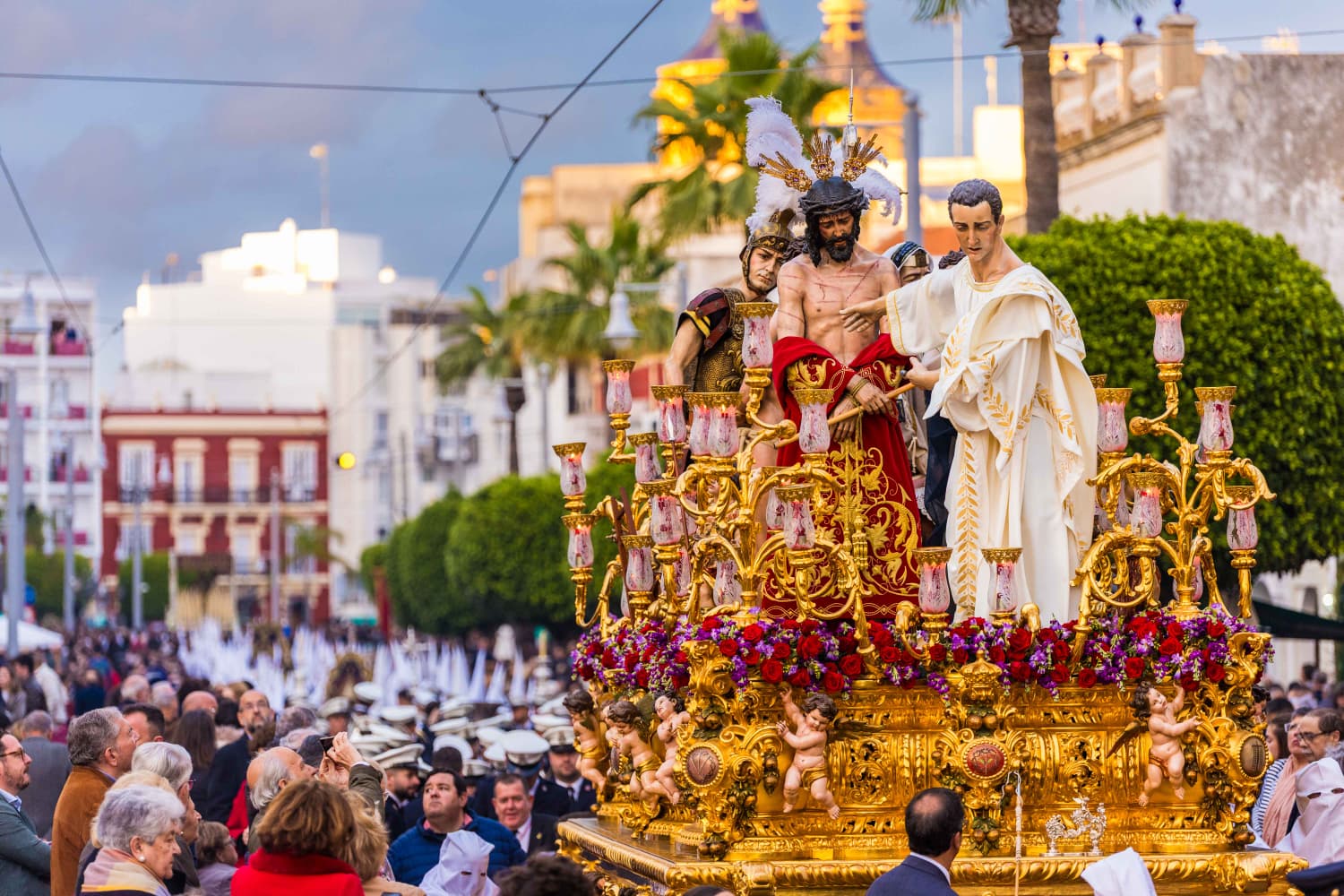
Holy Week 2026 in Andalusia will be lived from March 29 to April 5 as a great constellation of emotions spread across regional capitals, historic towns and medium-sized cities where the Passion takes many different forms. Andalusia does not offer just one Holy Week, but many: the Holy Week of silence and saetas, of crowds and dawn processions, of intimate devotion and of legendary moments that form part of collective memory.
Seville: the city of the Madrugá, Gran Poder and the emotion of Triana
In Seville, Holy Week unfolds on a unique scale, with nearly sixty brotherhoods and an atmosphere in which the saeta remains one of its great hallmarks. But if there is one mythical heart of the celebration, it is the Madrugá, when the city gathers around names that belong to the universal imagination of Sevillian Holy Week. Here appear the solemnity of Gran Poder, the deep devotion inspired by Esperanza de Triana, the classic elegance of La O, the strong personality of La Estrella, and the overwhelming image of El Cachorro, one of Seville’s greatest sacred icons. In Triana, one of the most eagerly awaited moments is the turn of Esperanza at the Altozano, a gesture that, for many, captures the emotion of the entire city.
Granada: Cristo de los Gitanos and the unforgettable night of the Sacromonte
If there is one image that captures the essence of Holy Week in Granada, it is that of Cristo de los Gitanos climbing among the caves and hillsides of the Sacromonte, surrounded by bonfires and by an urban scenery suspended between the popular and the sacred. On Holy Wednesday, the city gathers around Cristo del Consuelo and María Santísima del Sacromonte, while Holy Thursday brings emotion to the Albayzín, with beloved devotions such as Virgen de la Concha, La Estrella, La Aurora and Cristo del Silencio. Good Friday leaves other unmistakably Granadan scenes, including the human “mantle” of devotees and the act of La Soledad de San Jerónimo, with its historic “Chías”.
Málaga: El Cautivo, El Rico, the Legion and the great drama of the streets
Holy Week in Málaga has an intense relationship with the streets, with the crowds and with a visual liturgy of enormous power. One of its great spiritual centers is Jesús Cautivo, whose procession together with María Santísima de la Trinidad gathers a massive devotion year after year, with thousands of promises walking beside him. Added to this is the symbolic importance of El Rico, which preserves the historic privilege of freeing a prisoner on Holy Wednesday; the military presence of Cristo de la Buena Muerte with the Legion; and the magnetism of Los Gitanos, with Jesús de la Columna and María Santísima de la O. In Málaga, the Passion is experienced on a grand scale, with tronos, music and an extraordinary ability to turn each day into a major civic event.
Cádiz: elegance, saetas and an official route with its own character
In Cádiz, Holy Week moves between sobriety, emotion and an urban setting that makes it unmistakable. The official route passes through iconic places such as Plaza de Candelaria, Montañés, Palillero, Novena and Ancha, while Compañía Street becomes one of those essential points where the whole city waits for its brotherhoods to pass. Here, names such as Nazareno, Medinaceli, Afligidos, Oración en el Huerto, Perdón, Siete Palabras, Buena Muerte, Descendimiento and La Palma take center stage in a Holy Week where silence, saetas sung from balconies, drum rolls and the sound of brass create a very distinctive atmosphere.
Córdoba: silence, Capuchinos and the beauty of the impossible
Holy Week in Córdoba has its own aesthetic: less about excess, more about depth. Here, silence, the saeta, the sound of the small bell, and those moments when the costaleros achieve the almost impossible by guiding the pasos through tiny doors and narrow streets all play a central role. The city finds some of its most unforgettable scenes in places such as the Roman Bridge, San Lorenzo, Capuchinos, the Jewish Quarter, San Francisco, El Potro and Santa Marina. And there is one setting that sums up Córdoba’s devotional personality: Capuchinos, with Virgen de los Dolores and the spiritual echo of Cristo de los Faroles, one of those places where time seems to stand still.
Jaén: El Abuelo and the dawn that defines an entire city
To speak of Jaén is to speak of the dawn of Good Friday and of an image that inspires immense devotion: Nuestro Padre Jesús Nazareno, “El Abuelo.” The departure from the Cathedral and his meeting with Virgen de los Dolores are among those legendary moments in which an entire city recognizes itself in the street. Jaén lives its Holy Week with contained intensity, with deep-rooted fervor and with a powerful emotion that reaches its height around this Nazareno, who for so many people in Jaén is the true face of the Passion.
Huelva: the dawn of El Nazareno and the solemnity of Santo Entierro
In Huelva, Holy Week also has a very clear rhythm. The dawn of Good Friday brings together key devotions such as El Perdón, Misericordia and El Nazareno, while Palm Sunday opens the great week with La Borriquita. Holy Wednesday is closely linked to the Virgin images of Victoria and Esperanza, and Good Friday reaches one of its great moments with the Santo Entierro, one of the city’s most solemn processions. Huelva combines popular emotion with ceremonial composure, and much of its Holy Week identity lies precisely there.
Almería: encounters, music and a distinctly unique Holy Week identity
Holy Week in Almería is distinguished by one very clear feature: the importance of encounters and of music as elements that almost structure the whole experience. In the provincial capital, the musical component can take on extraordinary significance, and Good Friday even preserves the presence of Gregorian chants. Among the references that stand out in 2026 are brotherhoods and moments linked to Encuentro, Silencio, Rosario del Mar and Angustias, especially on a highly meaningful Holy Thursday for the city. Almería thus offers a Holy Week of its own nuances, less easily replicated and very recognizable in the way it fills the streets with feeling.
Jerez: ancient flavor, El Nazareno and the saeta as a language
Holy Week in Jerez de la Frontera is one of Andalusia’s great references, with a strong personality and a very recognizable way of processing through the streets. Two ancient forms of understanding the act of penance stand out here, especially represented by Jesús Nazareno and Cristo de la Expiración, together with features such as single-shoulder pasos, horquillas and tunics in the so-called “Egyptian style.” Jerez also shines through moments and names that are almost part of its emotional heritage: the Cruz de Guía of Vera Cruz, the saeta trumpet of Mayor Dolor, the Stabat Mater of Las Angustias, the Miserere of Las Tres Caídas, and the iconographic depth of Prendimiento, Amargura, Desconsuelo, Remedios and Piedad. Here, the saeta is not an ornament; it is a language.
San Fernando: Huerto, Servitas, Silencio and streets turned into ritual
In San Fernando, Holy Week is experienced almost in urban sequences: there are streets that seem made to await a procession. Among the city’s most recognizable moments are Huerto with María Santísima de Gracia y Esperanza Coronada around Ancha Street or Santo Domingo; Servitas through the Callejón de las Ánimas; Vera Cruz, Tres Caídas and Gran Poder in places such as Venta de Vargas, Plaza de la Pastora or the rise over the Puente del Gran Poder; and brotherhoods such as Perdón or Silencio, the latter with public lighting switched off in part of its route, reinforcing an atmosphere of genuine recollection.
Pozoblanco: sayones, Verónica and a dawn with its own identity
Holy Week in Pozoblanco has a very singular character within the province of Córdoba. Here, Santísimo Cristo del Perdón and Nuestra Señora de la Amargura stand out on Holy Thursday, but above all there is the ritual universe of Good Friday, with the Brotherhood of Roman Soldiers and Penitent Sayones of Nuestro Padre Jesús Nazareno. Here unfold moments of great expressive strength such as the Prendimiento, the Canto de la Sentencia, the Madrugada, the meeting with Verónica, the meeting with Saint John and Virgen de los Dolores, and the Tres Caídas. These are joined by the Santo Entierro, La Soledad and, in Easter joy, the Resucitado.
Alcalá la Real: a theatrical and baroque Holy Week beneath La Mota
For those seeking something truly different, Alcalá la Real offers one of the most fascinating singularities in Andalusia. Its Holy Week preserves the so-called mimetic pasos, heirs to the Baroque sacramental plays, and maintains characters as recognizable as the sayones, the good thief, the bad thief and the rostrillos, in a staging that turns the morning of Good Friday into something absolutely unique. The backdrop of the Fortaleza de la Mota finally transforms this celebration into an experience of enormous personality.
Dos Hermanas: Nazareno identity and the strength of local devotions
In Dos Hermanas, the celebration has grown into one of the most notable Holy Weeks in the Seville metropolitan area. Among its visible references are Nuestro Padre Jesús Cautivo and María Santísima de la Esperanza, as well as pasos such as Pasión, within a Holy Week that is lived with strong civic participation. Dos Hermanas offers another way of understanding the Passion close to Seville: intimate, highly attended and increasingly established.
Marbella: Nazareno, Columna, Cautivo-Santa Marta and Holy Week by the sea
In Marbella, Holy Week presents a highly recognizable program, with processions and devotions that shape the local celebration: Pollinica Viviente, La Columna, Cautivo-Santa Marta, Nazareno, Calvario, Cristo del Amor, the devotion surrounding Nuestra Señora de la Amargura, and the culmination of the Resurrection. Among them, Nazareno stands out for its strong historical roots and for the presence of María Santísima del Mayor Dolor and the Santo Sepulcro, while the city projects a Holy Week that is alive, vibrant and full of its own personality.
And there is still much more: the boundless Andalusia of Holy Week
This map does not end here. The pulse of Andalusian Holy Week extends through many other towns and cities: Carmona, Utrera, Écija and Alcalá de Guadaíra in the province of Seville; Priego, Cabra, Lucena, Baena and Hinojosa del Duque in Córdoba; Jerez, San Fernando, San Roque, Arcos, Chiclana and Medina Sidonia in Cádiz; and Alcalá la Real itself in Jaén, among many others. This is, precisely, one of Andalusia’s greatest strengths: its Holy Week is not concentrated in a single postcard image, but multiplies across dozens of cities and towns where every Virgin image, every Christ, every brotherhood and every corner holds a different way of living the Passion.

Holy Week 2026 in Andalusia will once again show that here emotion does not belong only to the great capitals, but also to medium-sized cities, historic towns and places where faith, art and collective memory continue to be written in the streets. From Seville’s Madrugá to the Sacromonte of Granada, from El Cautivo in Málaga to El Abuelo in Jaén, from the sobriety of Córdoba to the distinct identity of Jerez, San Fernando, Pozoblanco, Dos Hermanas, Alcalá la Real and Marbella, Andalusia offers a rich, collective and deeply authentic journey. There is not just one Andalusian Holy Week: there are as many as there are gazes, brotherhoods and emotions in a land that lives the Passion like few others in the world.