
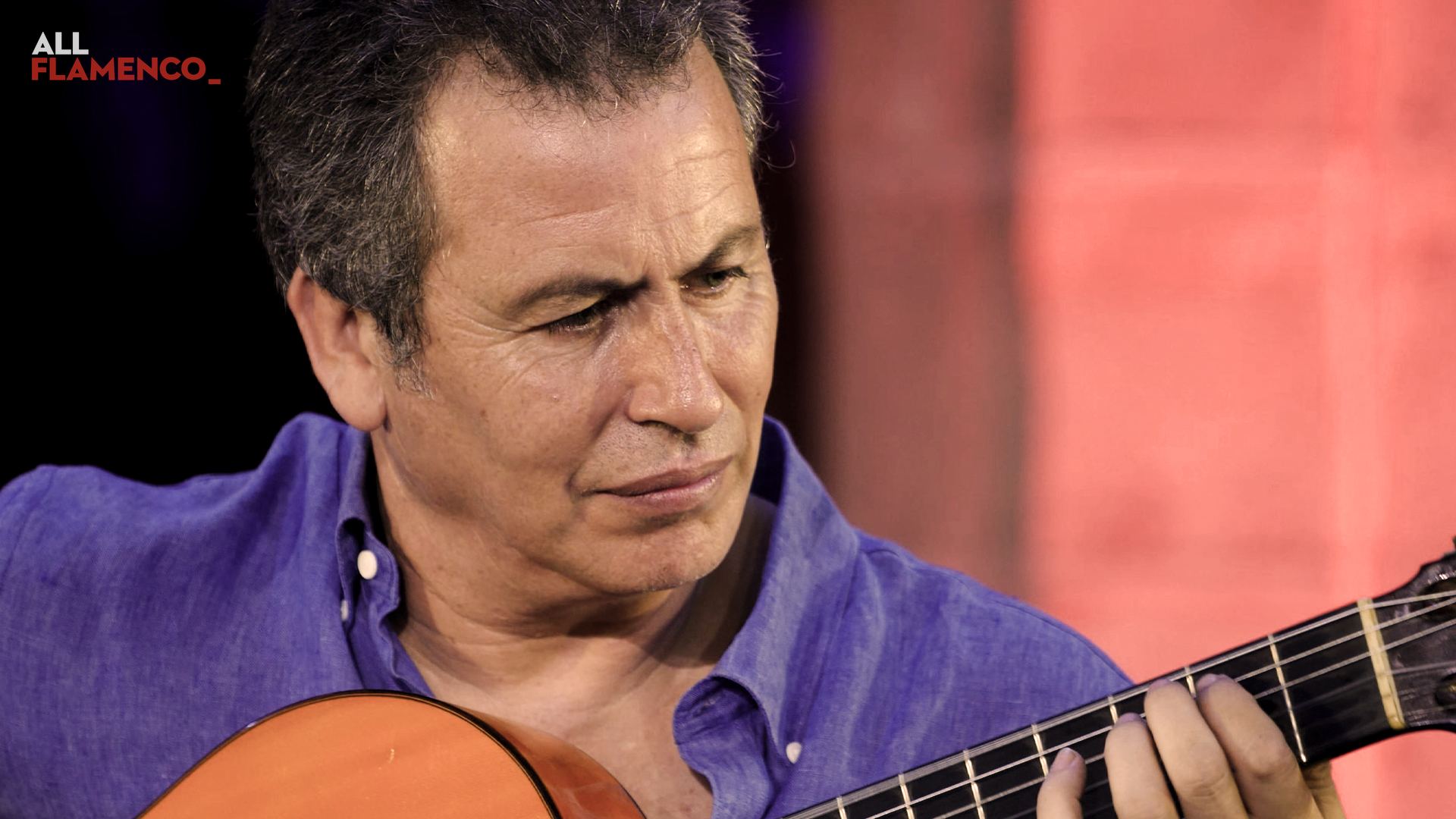
There is a kind of guitarist who never shows up on the lists of big names, and without whom the flamenco of a particular town makes no sense. In Jerez, Juan Diego Mateos is one of them. You find him leading his own trio, sitting behind a singer in a neighbourhood club, or alone on a festival stage with a dancer. All three things are on film, and all three are in our catalogue.
This article covers who he is, what he actually does when the label «flamenco jazz» gets attached to him —a label used a great deal and explained very little— and what you can watch of him on ALL FLAMENCO: from the complete concert to every piece on its own.
Who Juan Diego Mateos is: a Jerez touch that went looking for jazz
He is a guitarist and he is from Jerez, and both facts matter in that order. He is known as «the Jerez guitarist» and «the Jerez artist», and there is one word that keeps coming back whenever people describe his touch: elegant. «The elegant, personal touch of the guitarist Juan Diego Mateos»: that is how his concert is introduced. That is not filler: it is exactly what you hear.
His settled line-up is a trio. Him on guitar, Luis Román «El Yiyo» on saxophone and clarinet —he plays both instruments— and Alejandro Fernández on percussion. With that trio we filmed «Flamenco Jazz», at the Cloisters of Santo Domingo in Jerez de la Frontera.
And there is a second place where you can hear him talk, which in a guitarist is rare and worth its weight: «Vivamos el Flamenco with Juan Diego Mateos», filmed at the Teatro San Javier in Chile, where he explains his show with the presenter Pedro Alberto Sierra Espinosa in front of him.
Flamenco jazz is not flamenco with a saxophone: it is another way of dividing the compás
The label goes on easily and is almost always misread. «Flamenco jazz» does not mean a saxophone turns up where the handclaps used to be. It means two specific things, and in this concert’s repertoire you can point at both.
The first: the harmony opens up. Classical flamenco rests on a handful of chords that have worked for centuries; jazz puts a far more mobile chord sequence underneath and forces the melody to travel. When that happens without the air going out of it, the falseta still sounds flamenco even though the floor has moved.
The second: improvisation changes its rules. In flamenco you improvise inside the compás and inside the memory of the palo. In jazz you improvise over the structure of the tune. When a flamenco guitarist plays a standard, he has to decide phrase by phrase which of the two grammars he is obeying.
That is why a trio like this cannot be summed up in a label, and why each piece of the concert is also published on its own: they are easier to hear one at a time. And if the comparison helps, there is another place on the blog where this crossing is told from the flute rather than the guitar, in the documentary «Trance», about Jorge Pardo.
«Respira»: the album of his own behind three of the twelve pieces
Almost half the concert is not borrowed repertoire: it is his. Three of the twelve pieces come from his album «Respira», and they are the ones that best explain where he comes from. «Rondeña y Malika» is the one to hear if you are only going to hear one: it is classical flamenco playing «decorated with jazz melodies» — that is, the whole rondeña, with the jazz on top rather than the other way round. The other two are «Musgo» and «Kundalini».
There is a fourth piece of his own, «Esteve y aires de libertad», which opens with the guitar alone before the clarinet and the percussion come in. And there is one more piece that is not his and deserves a mention: «Ruega por nosotros», written by Antonio Soteldo «Musiquitas», where the guitar heads off towards classical technique and towards Latin American music.
Coltrane and Charlie Parker, played with a flamenco right hand
This is where the label gets tested, because 2 of the twelve pieces are real jazz standards, not nods to jazz.
«Soul eyes» is «the song John Coltrane made famous». Mateos opens it alone, with a long introduction, and only afterwards do the musicians come in and carry it to middle ground. It is the piece where you best appreciate what a flamenco guitar does to a ballad: the strumming almost entirely disappears and what is left is the thumb.
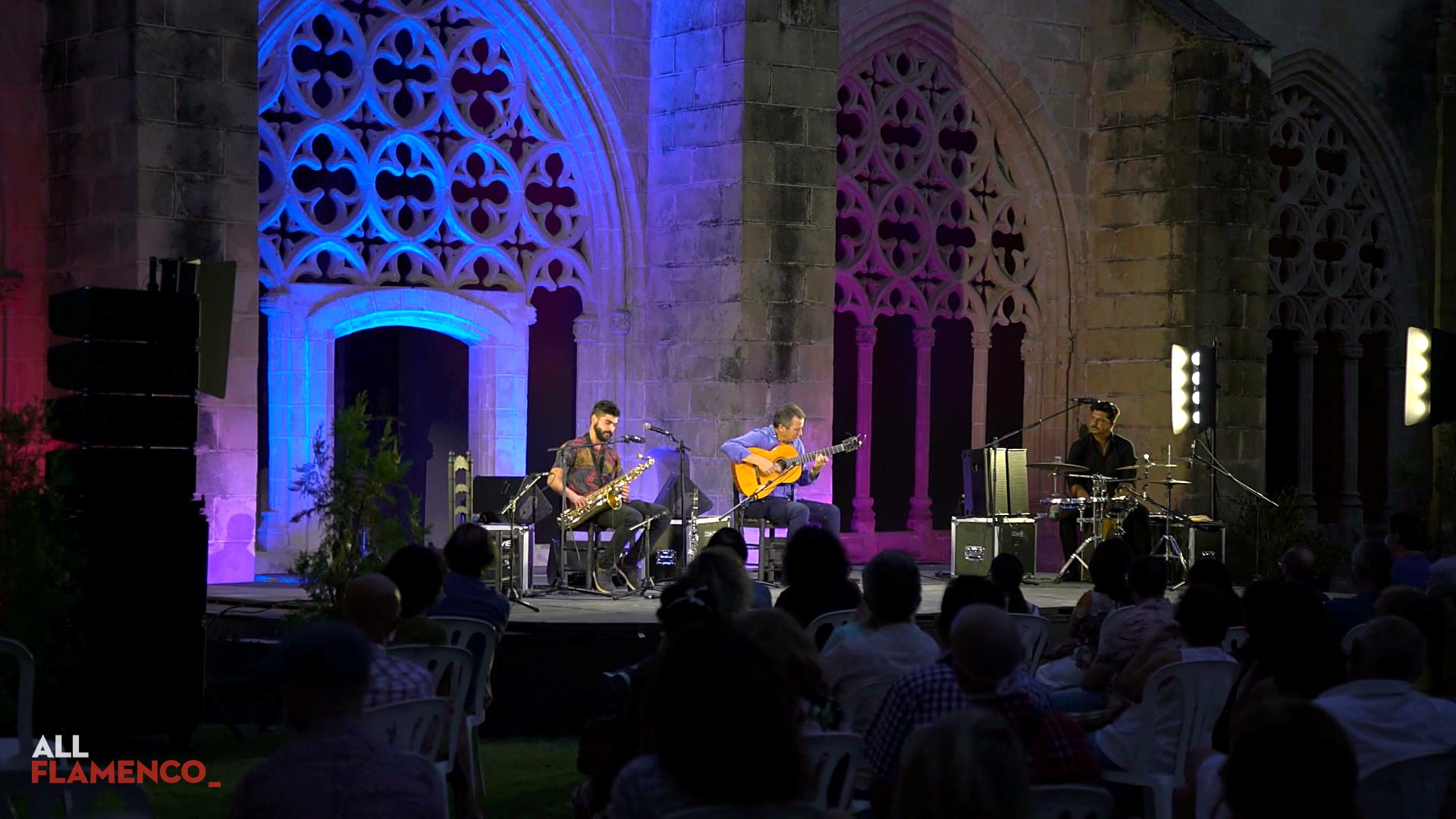
«All the things you are» goes the other way: it is «a Charlie Parker version» to which the man from Jerez brings «a very personal air», and the standard comes in where flamenco lets it in.
And the return journey is on film too. «Puga e Iván» runs por bulerías with jazz touches, which is the reverse operation: here the palo is in charge and the jazz decorates. Between those two pieces the whole argument about what this music is fits comfortably.
Diego Pozo, the guest almost nobody expects to find here
The concert has a guest, and it is a name from another world: Diego Pozo, of «Los Delinqüentes». So the concert itself says, from its first line, and in three of the twelve pieces he is named: «Kundalini», where he plays as guest artist; «Masagua», which he performs on his guitar; and «Dieguito», where he accompanies Mateos.
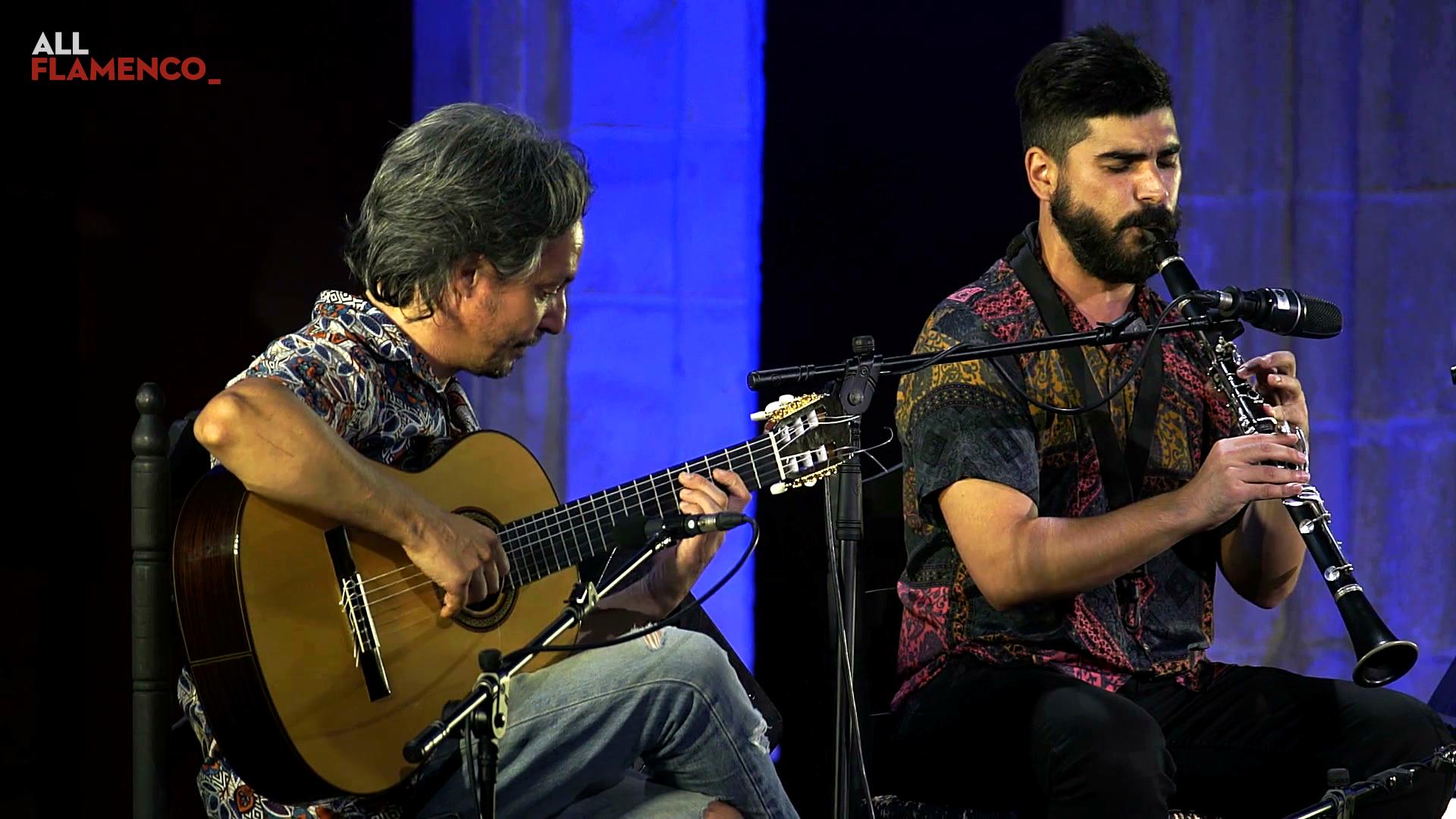
It is the kind of meeting nobody programmes for marketing reasons, and it explains rather well what sort of musician the host is: someone who will sit down and play with a man out of street songwriting exactly as he will sit down and play a Coltrane tune. Everything about him on ALL FLAMENCO is here, and «Dieguito» is on its own here.
The other Mateos: the guitarist who sits behind the singer
A concert guitarist and an accompanying guitarist are not the same trade, and few people do both well. This one does.
With the dancer Belén Maya he made «Ni tú, ni yo», from the 24th Festival de Jerez. That is exactly what it is: he «creates a musical atmosphere» and she performs it with her body. A guitar-and-dance show, with no singing, held up by two people.
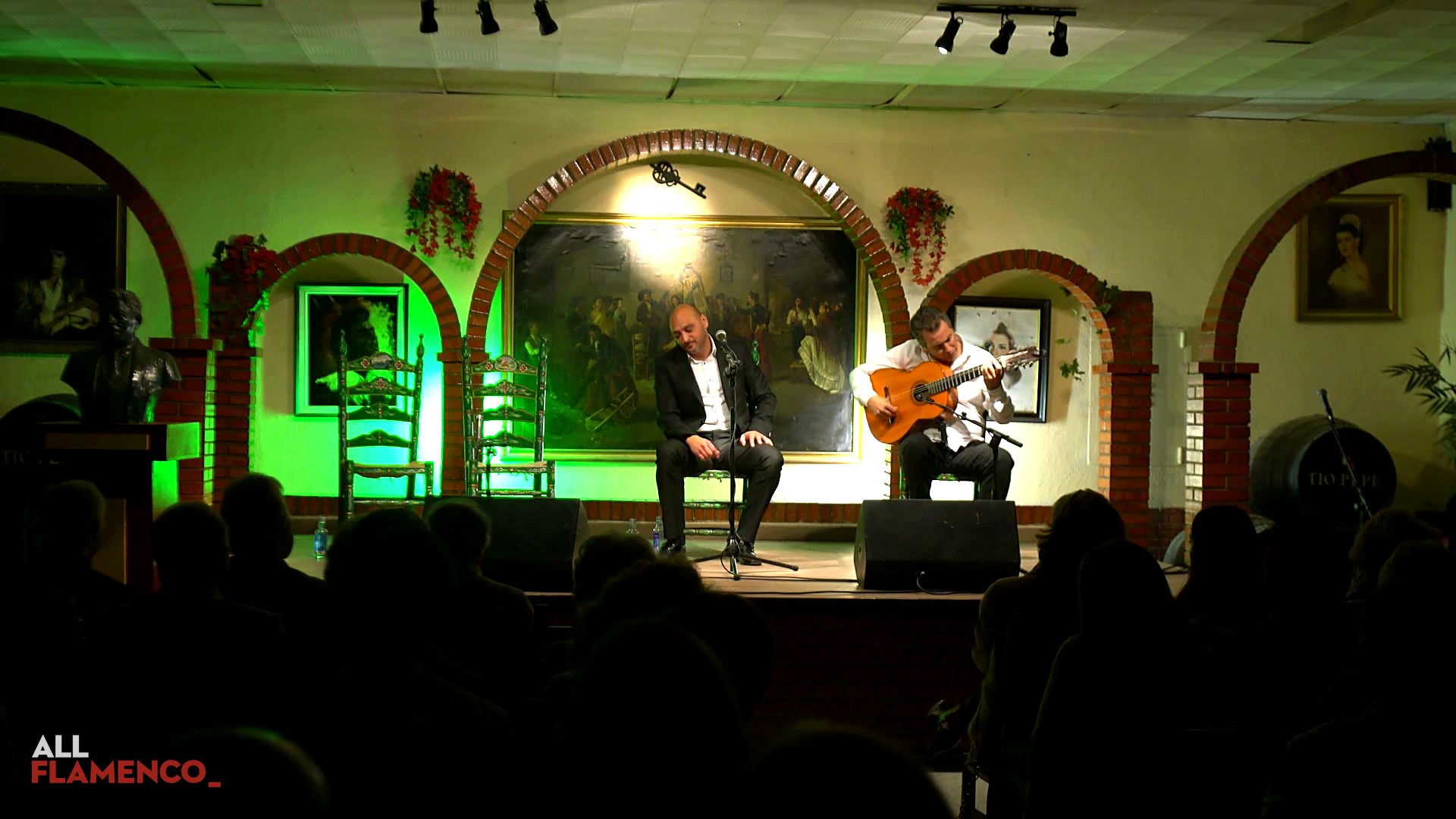
And then there is the less showy and more revealing work: he also plays guitar behind the singer Momo Moneo at the Peña Flamenca Los Cernícalos in Jerez —fandangos, seguiriyas, soleá and tientos tangos— with José Rubichi and Manuel Cantarote on handclaps. There is no open harmony there and no standards: there is a pure guitarist accompanying a voice from the San Miguel quarter. It is the same man.
All of Juan Diego Mateos on ALL FLAMENCO
It is all together on ALL FLAMENCO: the complete concert, its pieces published separately, the conversation of «Vivamos el Flamenco», and the performance with Belén Maya from the 24th Festival de Jerez.
If you want somewhere to start, there are two sensible doors: «Vivamos el Flamenco», to get your bearings fast, or the rondeña and then the whole concert.
The rest —the festivals, the neighbourhood clubs, the full concerts— is in the ALL FLAMENCO catalogue, and to watch it all you just need to subscribe.


