
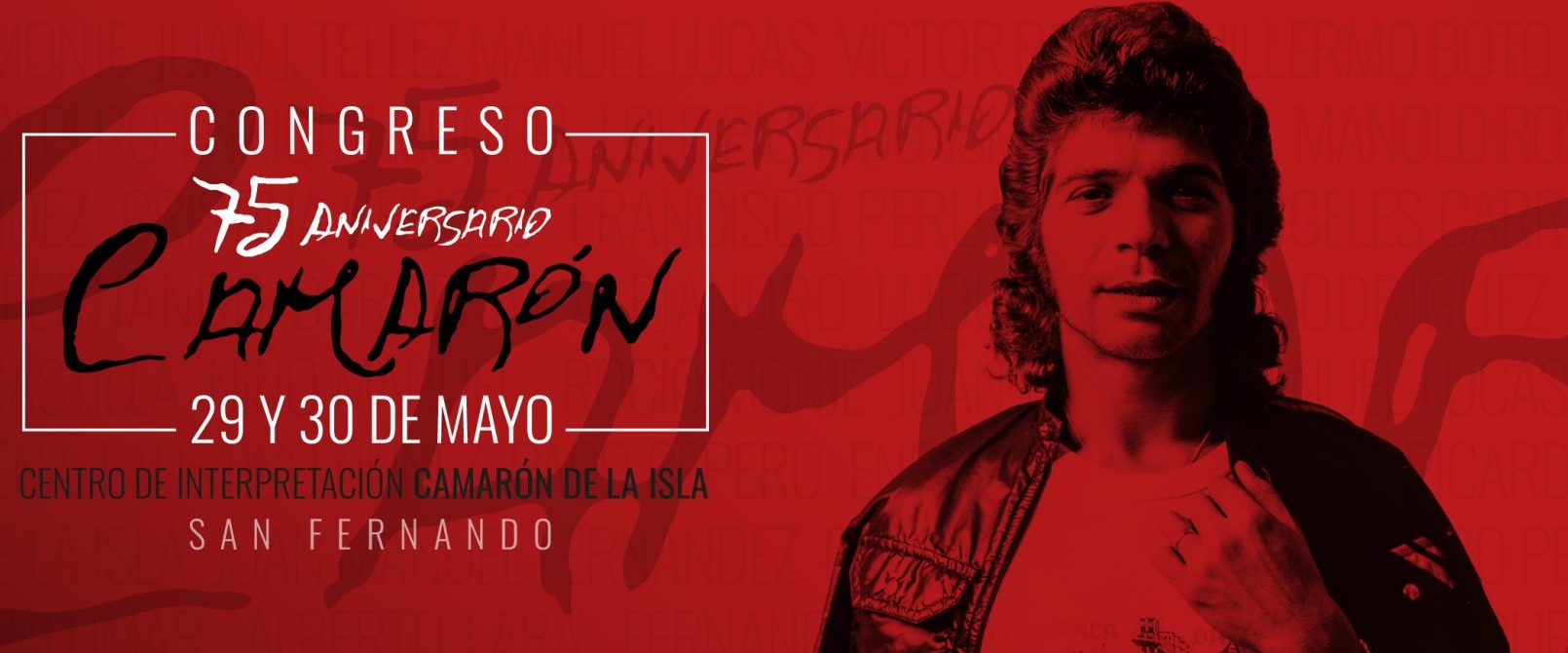
San Fernando is once again turning its eyes, its memory and its deepest flamenco heartbeat toward Camarón de la Isla. On May 29 and 30, 2026, the Centro de Interpretación Camarón de la Isla will host the Camarón 75th Anniversary Congress, a major cultural gathering devoted to the life, work and continuing influence of one of the most decisive voices in flamenco history.
The congress will bring together members of Camarón’s family, artists, researchers, journalists, educators, writers and leading flamenco specialists. Its programme is structured around four essential perspectives: institutional, academic, educational and artistic. This approach reflects the true scale of Camarón’s legacy: he was not only a legendary cantaor, but also a cultural turning point whose influence continues to shape the way flamenco is performed, studied, taught and experienced today.
Camarón de la Isla: 75 Years of a Voice That Still Lives On
Some artists belong to their time. Others, very few, manage to transform time itself. Camarón de la Isla belongs to that second category.
Born José Monje Cruz in San Fernando, Cádiz, Camarón became one of the most influential flamenco singers of the 20th century. His voice, his phrasing, his emotional depth and his instinctive understanding of flamenco tradition created a before and after in the history of cante. He did not merely inherit a tradition: he intensified it, questioned it, renewed it and opened it to future generations.
The 75th anniversary of his birth is therefore much more than a commemorative date. It is an opportunity to return to Camarón not as a distant myth, but as a living presence. His recordings continue to move new listeners around the world. His artistic partnership with Paco de Lucía remains one of the great chapters in flamenco history. His daring approach to albums such as La Leyenda del Tiempo still raises questions about tradition, innovation and artistic freedom.
That is why this congress is so necessary. It does not simply celebrate Camarón as an icon. It invites us to think about him, listen to him again, understand his context and measure the lasting impact of his art on flamenco, education, research and contemporary culture.
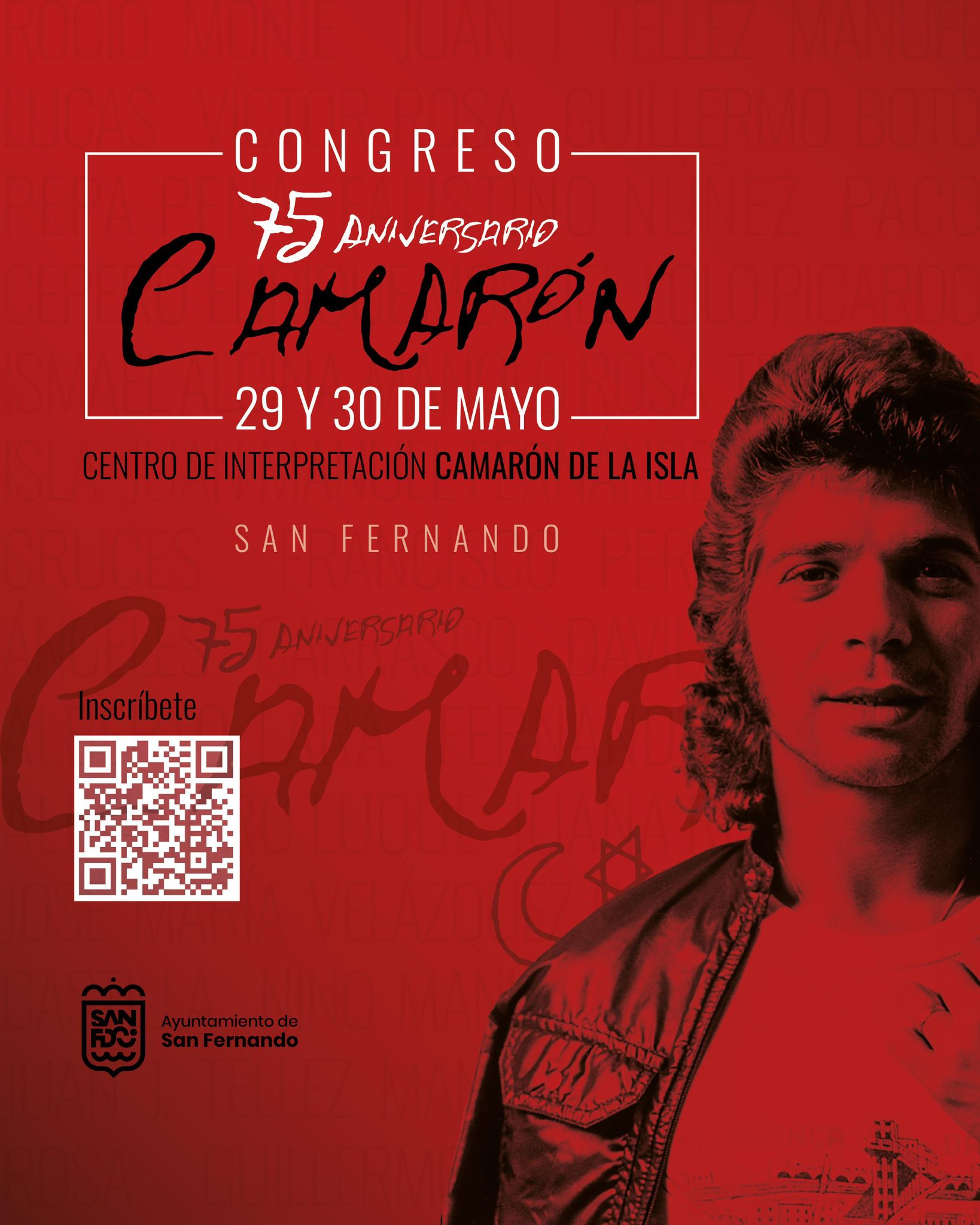
San Fernando: The Emotional Geography of Camarón
To understand Camarón, one must also understand San Fernando. The city known as La Isla was not just his birthplace; it was the emotional and cultural landscape from which his art emerged.
Its streets, families, peñas, gatherings, local singers and everyday flamenco atmosphere formed part of the world that shaped José Monje Cruz before he became Camarón de la Isla. In San Fernando, his name is not simply remembered. It is lived. It belongs to the city’s identity, its collective memory and its way of understanding flamenco as something intimate, popular and universal at the same time.
The choice of the Centro de Interpretación Camarón de la Isla as the venue gives the congress a powerful symbolic meaning. This is not a neutral space. It is a place created to preserve and share Camarón’s legacy, allowing visitors to connect with his biography, his artistic journey and the cultural environment that surrounded him.
For two days, San Fernando will become a meeting point for those who want to approach Camarón from different angles: memory, scholarship, artistic testimony, pedagogy and live performance. The congress will remind us that the singer from La Isla was never an isolated phenomenon. He belonged to a living flamenco ecosystem, and at the same time he transformed that ecosystem forever.
Four Perspectives: Institution, Academia, Education and Art
The official programme presents the congress through four main areas: institutional, academic, educational and artistic. This structure is one of the most interesting aspects of the event, because it allows Camarón’s legacy to be understood beyond biography or admiration.
The institutional perspective reflects how flamenco has gained cultural recognition over recent decades. The official congress dossier recalls that flamenco was declared Intangible Cultural Heritage of Humanity by UNESCO in 2010, a milestone that confirms the growing recognition of this art form at an international level.
The academic perspective is equally important. Flamenco is now studied from fields such as musicology, anthropology, cultural studies, history and education. Camarón’s work is especially rich for researchers because it brings together many of the central questions of flamenco: oral tradition, innovation, identity, recording culture, artistic myth, popular reception and the relationship between cante and guitar.
The educational perspective asks how flamenco is transmitted today. How do we teach flamenco to children, young students or international audiences? How can Camarón be explained without reducing him to a cliché? How can his work help new generations understand both the roots and the evolution of flamenco?
Finally, the artistic perspective brings everything back to the source. Camarón was, above all, an artist. A cantaor. A voice capable of making flamenco feel ancient and new at the same time. The congress will close each day with live performances, reminding us that flamenco is not only something to be studied or preserved, but something to be experienced.
Friday, May 29: Family, La Leyenda, Paco and the Making of an Artist
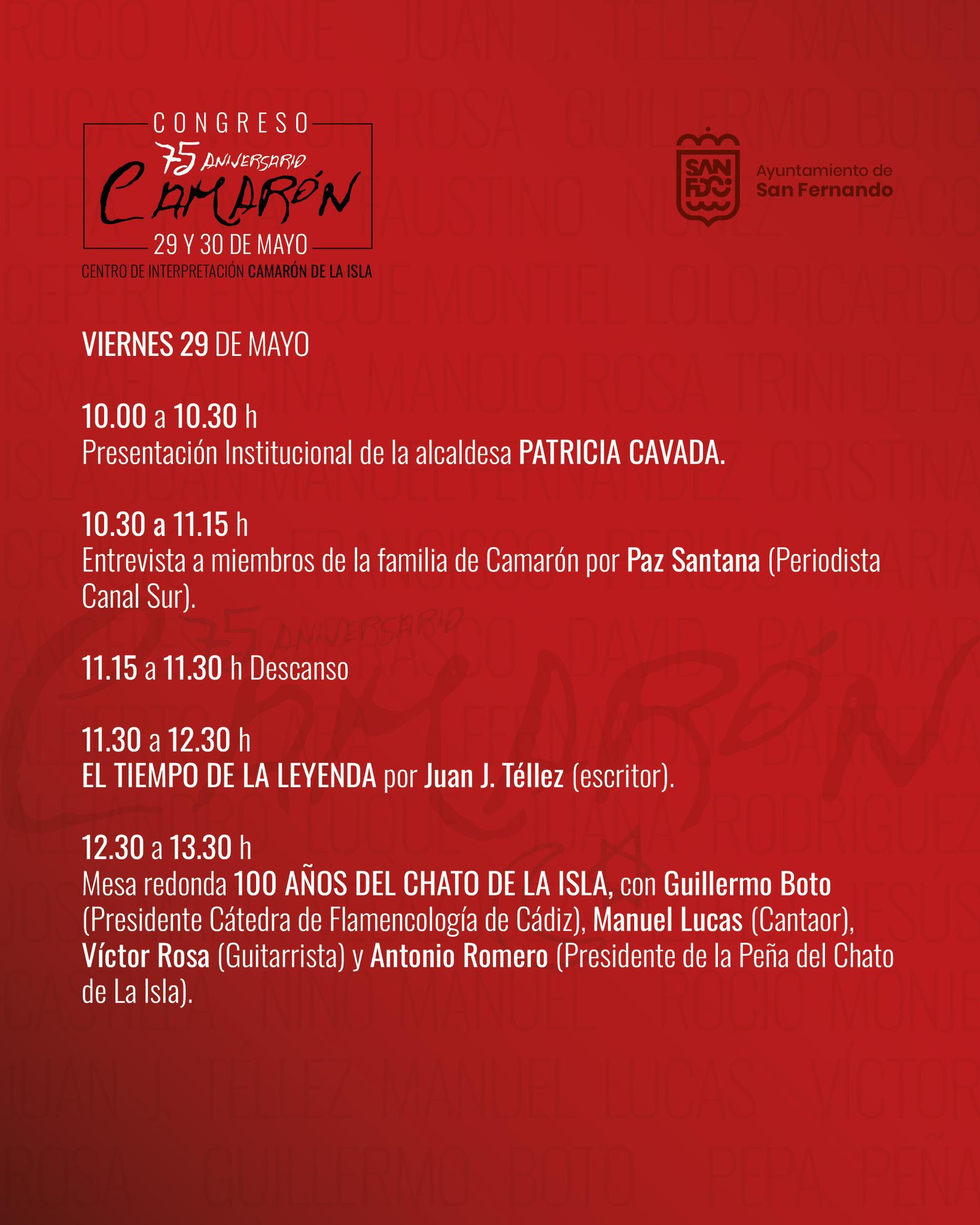
The first day will begin with an institutional presentation, followed by an interview with members of Camarón’s family conducted by journalist Paz Santana from Canal Sur. This opening places personal and family memory at the heart of the congress, an essential gesture when speaking about an artist whose public myth has always remained connected to a deeply human and intimate dimension.
Writer Juan J. Téllez will then present “El tiempo de La Leyenda”, a session devoted to one of the most symbolic works in Camarón’s career: La Leyenda del Tiempo. Released in 1979, the album opened a new aesthetic path for flamenco and has become one of the most discussed and influential records in the genre’s modern history. The congress dossier specifically highlights its importance as an album that introduced a new artistic proposal with far-reaching possibilities.
The morning programme will also include a round table on the 100th anniversary of Chato de La Isla, with Guillermo Boto, president of the Cádiz Chair of Flamencology; singer Manuel Lucas; guitarist Víctor Rosa; and Antonio Romero, president of the Peña del Chato de La Isla. This session widens the focus and places Camarón within the broader flamenco tradition of San Fernando.
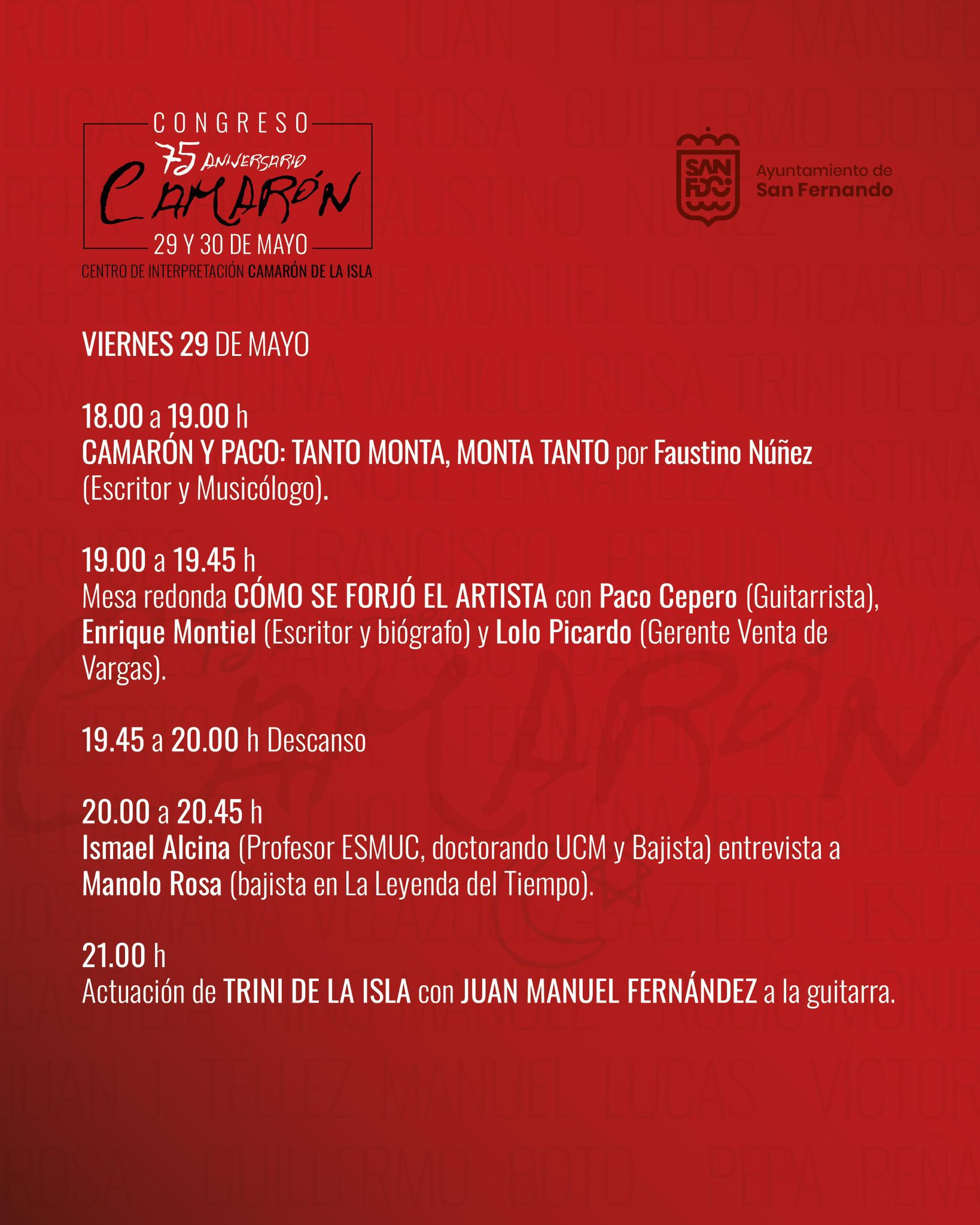
In the afternoon, writer and musicologist Faustino Núñez will give the talk “Camarón y Paco: tanto monta monta tanto”, dedicated to the extraordinary artistic relationship between Camarón de la Isla and Paco de Lucía. Their partnership reshaped the dialogue between cante and guitar, creating a new level of intensity, precision and expressive freedom.
The round table “Cómo se forjó el Artista” will feature Paco Cepero, Enrique Montiel and Lolo Picardo, manager of Venta de Vargas. This session promises to explore the formative years of Camarón: the places, people, encounters and musical environments that helped shape the artist before he became a legend.
The day will also include a conversation between Ismael Alcina, professor at ESMUC and doctoral researcher at the Complutense University of Madrid, and bassist Manolo Rosa, who took part in La Leyenda del Tiempo. Their session, “Nuevos sonidos para un Nuevo Flamenco”, will examine the new sounds that contributed to a changing flamenco language. The evening will close with a performance by Trini de La Isla, accompanied by Juan Manuel Fernández on guitar.
Saturday, May 30: Research, Education, Childhood and Legacy
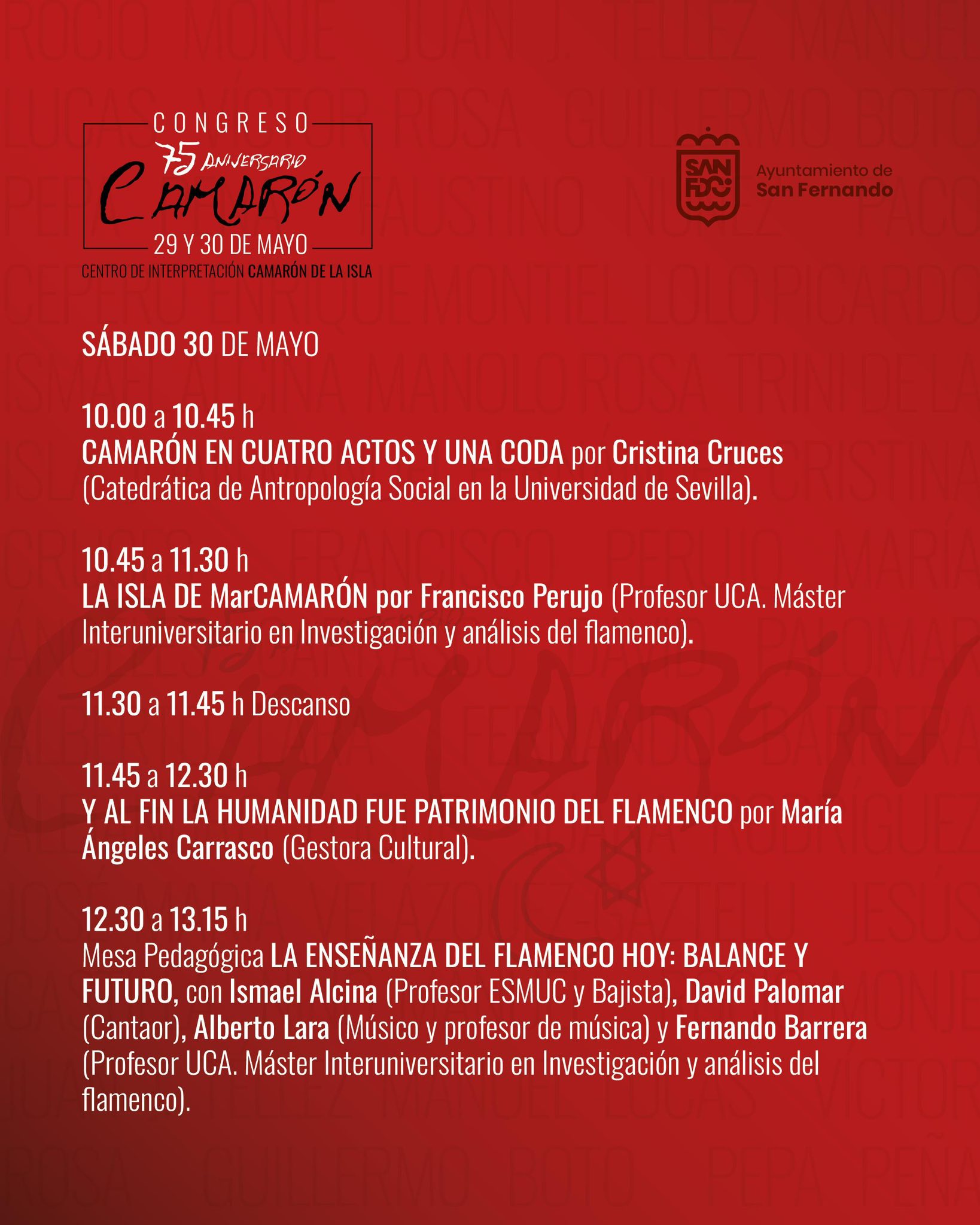
The second day will open with Cristina Cruces, professor of Social Anthropology at the University of Seville, who will present “Camarón en cuatro actos y una coda”. Her presence reinforces the academic dimension of the congress and offers a broader cultural and anthropological reading of Camarón’s figure.
She will be followed by Francisco Perujo, professor at the University of Cádiz and linked to the Inter-University Master’s Degree in Flamenco Research and Analysis, with the talk “La Isla de marCamarón”. The title itself suggests a reflection on the relationship between territory, memory and myth: the real San Fernando and the symbolic San Fernando that Camarón helped project to the world.
Later in the morning, cultural manager María Ángeles Carrasco will present “Y al fin la Humanidad fue Patrimonio del Flamenco”, a session that will reflect on flamenco’s recognition as heritage and on the cultural processes that have helped dignify, protect and promote this art form.
One of the key moments of the day will be the educational round table “La enseñanza del Flamenco hoy: balance y futuro”, with Ismael Alcina, David Palomar, Alberto Lara and Fernando Barrera. This conversation is especially relevant today, as flamenco is increasingly present in schools, conservatories, universities, cultural projects and digital learning environments. Teaching flamenco means much more than explaining styles or historical names. It means transmitting a way of listening, feeling, moving and understanding cultural memory.
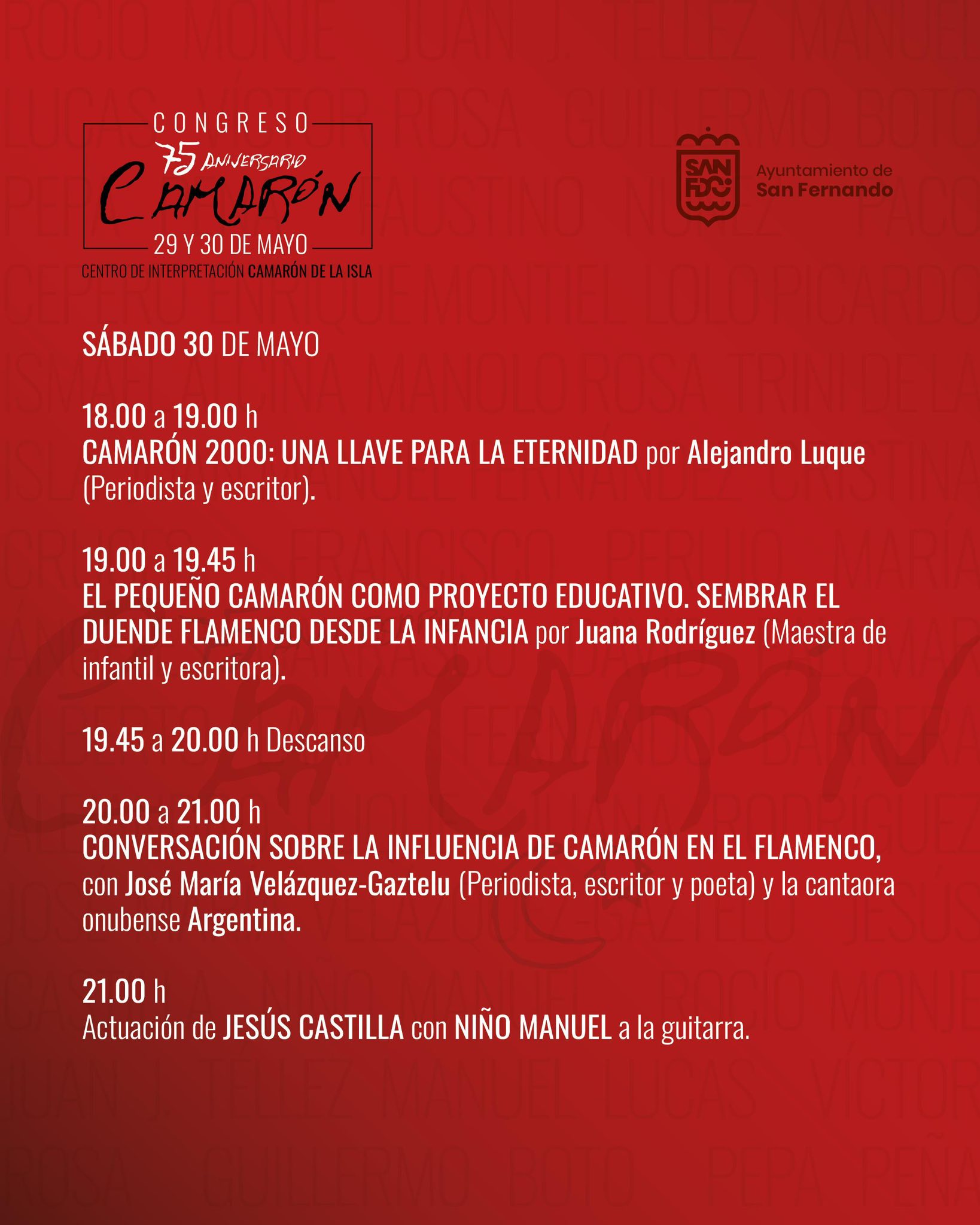
The afternoon will feature writer and journalist Alejandro Luque with “Camarón 2000: una llave para la eternidad”, followed by Juana Rodríguez, early childhood teacher and writer, with “El pequeño Camarón como proyecto educativo. Sembrar el duende flamenco desde la infancia.” This educational approach opens a particularly meaningful path: bringing flamenco to children not as something distant or museum-like, but as a living emotional and cultural experience.
The final conversation will be led by José María Velázquez-Gaztelu, journalist, writer and poet, together with the singer Argentina, focusing on Camarón’s influence on flamenco. The congress will close with a performance by Jesús Castilla, accompanied on guitar by Niño Manuel.
La Leyenda del Tiempo: The Album That Still Opens Questions
Although the congress covers many aspects of Camarón’s legacy, La Leyenda del Tiempo inevitably stands at the centre of the conversation. Few albums in flamenco have generated such intense debate, admiration and reinterpretation.
Its importance lies not only in its musical innovations, but in the question it continues to ask: how can flamenco evolve without losing its roots?
At the time of its release, the album challenged expectations. Over the years, however, it has come to be understood as a visionary work. It opened flamenco to new sounds, new textures and new poetic possibilities, while keeping Camarón’s unmistakable voice at the centre of the experience.
But La Leyenda del Tiempo should not be reduced to the label of “revolutionary album”. Its deeper value is that it forced flamenco to look at itself differently. It revealed that tradition is not a closed museum, but a living force. Camarón did not break with flamenco. He expanded its horizon.
The congress is right to return to this album not as a relic, but as a living question. What does innovation mean in flamenco today? Where is the balance between respect and risk? How can new generations create without losing the memory of what came before? Camarón did not answer these questions in theory. He sang them.
Camarón and Paco de Lucía: A Dialogue That Changed Flamenco
No reflection on Camarón would be complete without Paco de Lucía. Their artistic relationship remains one of the most extraordinary encounters in the history of flamenco.
Paco brought architecture, rhythmic clarity, harmonic imagination and a new conception of the guitar. Camarón brought a voice that seemed to come from both the deepest past and the most daring future. Together, they created a language that transformed the relationship between singer and guitarist.
Their recordings did not simply modernise flamenco. They deepened it. They showed that renewal could come from within the tradition itself. For many listeners around the world, Camarón and Paco became the gateway into flamenco: the first shock, the first revelation, the first emotional connection with an art form that would later lead them to discover older masters, palos, family traditions and local scenes.
That is why Faustino Núñez’s session on Camarón and Paco will be one of the most anticipated moments of the congress. It will allow audiences to revisit not only a legendary partnership, but a shared artistic language that still shapes flamenco today.
Teaching Camarón: How to Pass On a Revolution
One of the most valuable aspects of the congress is its attention to education. For centuries, flamenco was transmitted through families, local communities, professional circles, informal gatherings and direct artistic practice. Those forms of transmission remain essential. But today flamenco is also taught in schools, universities, conservatories, workshops, cultural centres and online platforms.
This creates a new challenge: how do we teach flamenco without simplifying it? How do we explain Camarón to someone who has never heard him before? How do we move beyond the myth and help students understand the actual artistic transformation he represented?
Teaching Camarón means explaining that he was both rooted and revolutionary. It means placing him in relation to San Fernando, to family traditions, to Paco de Lucía, to the recording industry, to the social changes of his time and to the later generations that inherited his influence.
It also means teaching people how to listen. Camarón’s art cannot be understood only through dates and facts. It requires attention to tone, silence, rhythm, emotional tension and the mysterious quality flamenco calls duende.
The educational sessions in the congress recognise that Camarón’s legacy is not only for experts or lifelong aficionados. It can also be introduced to children, students and new audiences as a way of opening the door to flamenco itself.
A Necessary Congress for an Inexhaustible Artist
Why does Camarón still matter so much? Because his voice continues to generate meaning. Because every generation hears him differently. Because flamenco today still lives in dialogue with the paths he opened. Because his art has not lost its power to move, disturb and inspire.
The Camarón 75th Anniversary Congress is important because it avoids a single, simplified view of the artist. It is not only a tribute, although emotion will certainly be present. It is not only an academic event, although research plays a central role. It is not only an institutional celebration, although cultural recognition is essential. And it is not only an artistic programme, although live performance remains at its heart.
Its strength lies in the combination of all these dimensions. Camarón is approached as a family memory, a local symbol, a research subject, an educational challenge, a flamenco revolution and an artistic presence that continues to speak to the present.
For two days, San Fernando will become more than a venue. It will become a place of listening. A place where the flamenco world gathers not only to remember Camarón, but to ask what he still has to say today.
Practical Information
The Camarón 75th Anniversary Congress will take place on May 29 and 30, 2026, at the Centro de Interpretación Camarón de la Isla in San Fernando, Cádiz. Registration is available through the official form provided by the organisers.
Registration: https://forms.gle/iaLN8MqCEhaQGcuRA
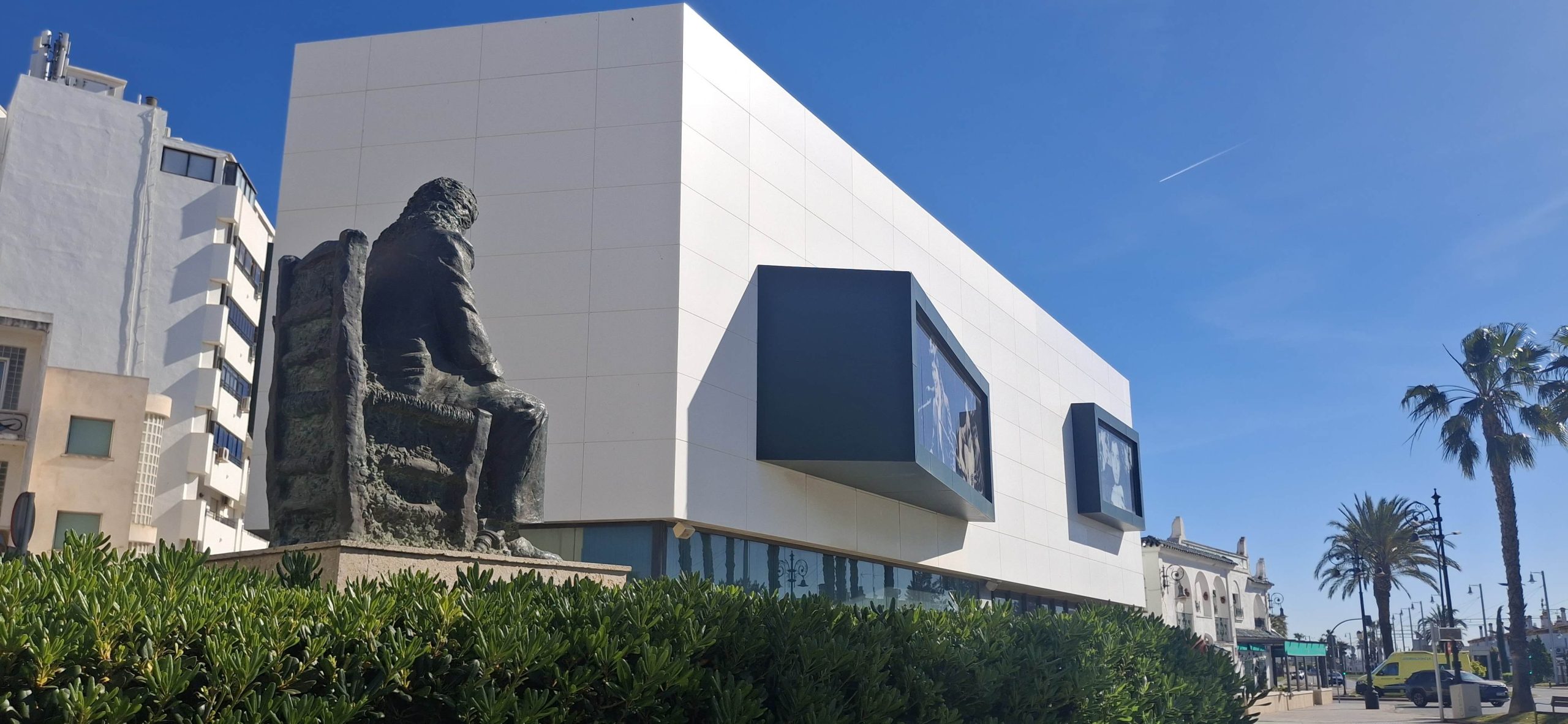
Foto Museo de Camaron. Flamenco de La Isla
ALL FLAMENCO Recommends: Keep Listening to Camarón
The congress will offer an exceptional opportunity to reflect on Camarón through words, memories, research and live performance. But the best way to continue that experience is to keep listening.
At ALL FLAMENCO, we believe that flamenco must be approached with both knowledge and emotion. Concerts, recitals, documentaries, interviews and audiovisual archives allow audiences around the world to understand that flamenco is not a fixed monument, but a living culture in constant movement.
Camarón opened paths that are still being explored. Listening to him today is not only an act of memory. It is a way of understanding the present and future of flamenco.
When and where will the Camarón 75th Anniversary Congress take place?
The Camarón 75th Anniversary Congress will take place on May 29 and 30, 2026, at the Centro de Interpretación Camarón de la Isla in San Fernando, Cádiz. This location is especially meaningful because San Fernando was the birthplace of Camarón de la Isla and remains central to his personal, cultural and artistic identity. The venue itself is dedicated to preserving and sharing his legacy, making it the ideal setting for a congress that brings together family members, artists, scholars, educators, journalists and flamenco specialists. Over two days, the programme will include institutional presentations, interviews, lectures, round tables, conversations and live performances. The event aims not only to commemorate the 75th anniversary of Camarón’s birth, but also to examine how his influence continues to shape flamenco today. It will explore his importance from institutional, academic, educational and artistic perspectives, offering a broad and thoughtful reflection on one of the most influential singers in flamenco history.
Why is Camarón de la Isla still so important in flamenco today?
Camarón de la Isla remains essential because he transformed the way flamenco is heard, performed and understood. His voice carried an extraordinary emotional intensity, but his importance goes far beyond vocal expression. He represented a turning point between inherited tradition and a new artistic sensibility. Camarón showed that flamenco could evolve without abandoning its roots. His collaboration with Paco de Lucía renewed the relationship between cante and guitar, creating a musical language that continues to influence artists today. His work also helped flamenco reach wider audiences, including younger listeners and people outside traditional flamenco circles. Albums such as La Leyenda del Tiempo opened debates about innovation, risk and authenticity that remain relevant. For scholars, educators and artists, Camarón is a key figure because his career brings together many of flamenco’s central questions: tradition, modernity, identity, territory, artistic freedom and emotional truth. His legacy is not static; it continues to inspire new interpretations and new generations.
Why is La Leyenda del Tiempo so important?
La Leyenda del Tiempo is important because it became one of the most symbolic turning points in modern flamenco. Released in 1979, the album challenged many expectations about what flamenco could sound like. It introduced new musical textures and a new aesthetic approach, while keeping Camarón’s voice at the centre of the experience. At first, the album was controversial for part of the traditional audience, but over time it has become widely recognised as a visionary work. Its importance lies in the way it opened a path for future experimentation in flamenco. It asked a question that remains alive today: how can flamenco move forward while remaining connected to its roots? The congress will return to this album through different sessions, including reflections on “The Time of La Leyenda” and the role of new sounds in Nuevo Flamenco. More than a historical record, La Leyenda del Tiempo continues to function as a living reference point for artists, researchers and listeners.
How can people register for the congress?
Registration for the Camarón 75th Anniversary Congress is available through the official form provided by the organisers: https://forms.gle/iaLN8MqCEhaQGcuRA. According to the information supplied in the official congress dossier, the event is organised by San Fernando City Council and produced by Flamenco de La Isla. The coordination is led by Carlos Rey, while press and communication are handled by Javier Fernández. Anyone interested in flamenco history, Camarón’s legacy, flamenco education, research, performance or cultural heritage will find this congress especially valuable. Since the programme includes major speakers, family testimony, academic sessions and live performances, early registration is recommended. For visitors coming from outside Cádiz, the congress also offers an opportunity to discover San Fernando and the Centro de Interpretación Camarón de la Isla, connecting the experience of the event with the city that shaped one of flamenco’s greatest artists.