
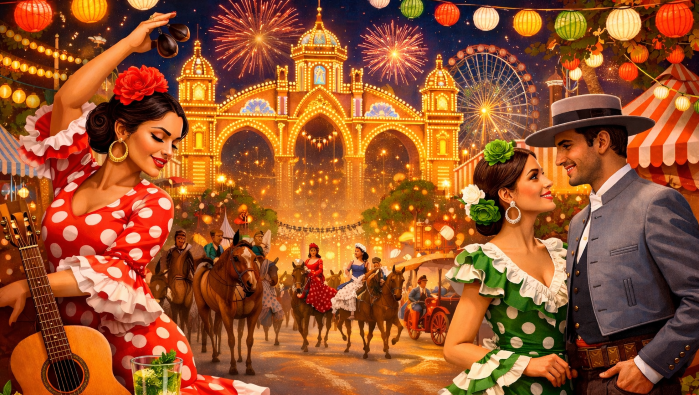
Andalusia’s 2026 fairs: when celebration also tells the story of a land
To speak about Andalusia is to speak about a way of living in the street, of understanding music as a meeting point, and of turning the calendar into a sequence of shared moments. Fairs are part of that way of feeling. They are not simply popular festivals or ordinary leisure events. For many cities, they are the week when a community recognizes itself, shows its identity to those arriving from elsewhere, and blends tradition, beauty, gastronomy, custom, and emotion.
A fair contains many layers at once. There is the visual beauty of ruffles, shawls, and sandy fairgrounds. There is the music that accompanies every stroll. There is the slow conversation, the gathering of friends, the reunion of families, and the visitor who discovers a very different way of celebrating. And there is also that distinctly Andalusian blend of ceremony and spontaneity: what follows tradition and what arises naturally, what is inherited and what each generation reshapes without ever fully breaking with the past.
In 2026, Andalusia once again offers a particularly attractive calendar for those who want to follow its best-known fairs. Some are internationally famous, such as Seville or Jerez. Others have deep local roots and a very distinctive personality, such as Córdoba, Granada, Huelva, Málaga, Almería, or Jaén. Alongside them are fairs that complete the Andalusian festive map beautifully and deserve a place in any serious article on the subject: Dos Hermanas, Coria del Río, San Fernando, El Puerto de Santa María, and Algeciras.
This calendar is not only of interest to travelers. It is also valuable for anyone who loves Andalusian culture and wants to understand how celebration, city life, and popular art connect. At the fairs, people listen to music, dance, eat, dress up, and talk, but they also recognize a shared heritage. That is why fairs remain one of the best ways to understand Andalusia from within.
Calendar of the most popular fairs in Andalusia in 2026
Seville — April Fair: from April 21 to April 26.
El Puerto de Santa María — Spring Fair and Fino Wine Festival: from April 29 to May 4.
Dos Hermanas — Dos Hermanas Fair: from May 7 to May 10.
Jerez de la Frontera — Horse Fair: from May 9 to May 16.
Córdoba — Our Lady of Health Fair: from May 23 to May 30.
Granada — Corpus Fair: from May 30 to June 6.
Algeciras — Royal Fair: from June 20 to June 27.
San Fernando — Carmen and Salt Fair: from July 14 to July 19.
Huelva — Columbus Festivities: from July 29 to August 3.
Málaga — Málaga Fair: from August 15 to August 22.
Almería — Almería Fair and Festivities: from August 21 to August 29.
Coria del Río — Coria del Río Fair: expected from September 16 to September 20.
Jaén — San Lucas Fair and Festivities: from October 10 to October 19.
Seen as a whole, the calendar draws a very clear route. Andalusia concentrates a major block of fairs in spring, continues with powerful celebrations in summer, and finishes with September and October events that extend the season significantly. This makes the region one of the territories with the most continuous festive tradition in Spain.
Andalusian spring: the great heart of fair season
For many people, spring is the most emblematic moment in the Andalusian calendar. Not only because of the weather or the light, but also because it is when several of the most famous and beloved fairs take place. Within a few weeks, Seville, El Puerto de Santa María, Dos Hermanas, Jerez, Córdoba, and Granada follow one another, forming a very attractive sequence for anyone who wants to experience the festive pulse of southern Spain.
Seville, the most universal fair
Seville’s April Fair remains the most recognizable reference when people think of Andalusian fairs. Its 2026 edition will take place from April 21 to April 26. The fairground, the grand entrance gate, the horse parade, the sevillanas, and life inside the marquees create an image that has crossed borders and that, for many people, sums up a powerful and idealized vision of Andalusia.
What is interesting about Seville is that it works on several levels. For the visitor, it is a visual and emotional experience. For those who know it from within, it is a very specific form of social life, with its own codes, customs, and rhythm. It is not a fair designed merely to be observed. It is meant to be lived. That is why it continues to generate so much fascination year after year.
El Puerto de Santa María, fino wine and the spirit of Cádiz
As May approaches, El Puerto de Santa María celebrates its Spring Fair and Fino Wine Festival from April 29 to May 4. Its very name reveals its character. This is not only an urban fair, but also a celebration that visibly incorporates the local wine tradition and the social character of a city deeply connected to wine and to the Bay of Cádiz.
El Puerto also has a particularly welcoming profile for anyone looking for a fair with its own identity, less crowded than the most media-focused events and especially attractive for combining gastronomy, strolling, and a coastal getaway. In an article about the most popular fairs in Andalusia, including it adds not only geographical value but also richness of nuance.
Dos Hermanas, a major fair in Seville’s metropolitan area
The Dos Hermanas Fair, scheduled from May 7 to May 10, holds an important place in the popular calendar of Seville province. It does not have the international projection of the capital, but it does have enormous local and metropolitan strength. Its inclusion is important because it shows that Andalusia’s fair culture does not depend only on historic capitals, but also on cities with a strong life of their own and a very intense relationship with their celebrations.
Dos Hermanas also contributes a very everyday dimension of the Andalusian fair. Here, it becomes clear how these celebrations remain part of the real fabric of the city and are not only a tourist showcase. Editorially, that makes the article much richer.
Jerez, horses, wine, and rhythm
Jerez’s Horse Fair will be held from May 9 to May 16. Few fairs have such a clearly defined identity: horses, wine, equestrian elegance, hospitality, and a very natural connection to flamenco.
Jerez is not limited to offering a beautiful or well-attended fair. It offers a fair with artistic personality. For any flamenco lover, the city carries enormous symbolic weight, and that is reflected in the way the fair is experienced. There is a distinctly Jerez way of understanding rhythm, gathering, and celebration, and that spirit can also be felt in its fair.
Córdoba, accessibility and tradition
Córdoba’s fair will take place from May 23 to May 30 in El Arenal. Its place within Córdoba’s famous month of May gives it special value. It does not appear in isolation, but rather in the context of a whole month of life in the streets, patios, flower crosses, and cultural activity.
Córdoba is also often perceived as a particularly comfortable fair for visitors. Within a general guide to Andalusia, that matters, because not all readers are looking for the same thing. Some want the great iconic image of Seville, while others prefer an experience that is easier to explore and easier to enjoy from the very first moment.
Granada, a fair that is also the city’s major festival
Granada’s Corpus Fair will take place from May 30 to June 6. Granada contributes something very valuable to the overall article: it shows that Andalusian fairs do not all follow the same model. Some are built more around the marquee, others around the stroll, others around wine, and others around a broader urban and religious tradition.
Granada’s Corpus blends these different dimensions and turns them into a celebration with remarkable singularity. It is not only a fairground event, but also a major city festival surrounded by tradition, urban life, and heritage.
Summer fair season: Cádiz, Huelva, Málaga, and Almería keep the route going
To think that the main fair season ends in May would be to see only part of the picture. Andalusia continues celebrating throughout the summer with notable intensity. In June, July, and August, several cities take over and show that the Andalusian festive calendar is much longer than many people assume.
Algeciras, the major fair of the Campo de Gibraltar
Algeciras Royal Fair will take place in 2026 from June 20 to June 27. It is an important fair for several reasons. It has history, deep roots, and a central role within the Campo de Gibraltar region.
Including it in this article avoids an overly narrow focus on the Seville-Jerez-Córdoba axis and broadens the real map of Andalusia’s most vibrant fairs. Algeciras reminds us that Andalusia also celebrates from other urban centers with strong identities of their own.
San Fernando, the Bay fair with its own personality
San Fernando’s Carmen and Salt Fair will be held from July 14 to July 19. San Fernando adds a very interesting nuance to the Andalusian scene: that of a Bay fair combining festive tradition, popular atmosphere, and strong local identity.
The fair map of Cádiz province cannot be understood only through Jerez or El Puerto. San Fernando has its own place, and it deserves recognition. It is a fair that keeps a powerful connection to the city and to its particular way of living summer.
Huelva and the Columbus memory
Huelva’s Columbus Festivities will take place from July 29 to August 3. Their historical origin gives them a very distinctive foundation within the Andalusian context. While other fairs are shaped by patron saints, agricultural cycles, or specific local traditions, the Columbus celebrations incorporate a very recognizable historical memory.
That does not make them any less festive, but it does add a different narrative layer. Huelva contributes a fair with a clear personality, historical meaning, and a strong ability to draw crowds.
Málaga, the great urban fair of the summer
Málaga Fair will take place from August 15 to August 22. It remains one of the major events of the Andalusian summer and one of the fairs that best combines tourism, local participation, and external projection.
Málaga also has a very well-known dual personality: the lively atmosphere of the historic center during the day and the fairground life at night. This structure makes it appealing to different kinds of audiences and helps explain why it continues to occupy such a prominent place in any calendar of Spanish fairs.
Almería, the grand close of August
Almería Fair and Festivities will take place from August 21 to August 29. The fair in Almería reminds us of something important: Andalusia’s festive identity does not end in the most visible triangle of western Andalusia. Almería has its own summer, its own tradition, and a calendar that continues to gather the city around its fair.
Its presence in this article helps offer a genuinely Andalusian view of the fair phenomenon, rather than a selection limited to the most media-friendly cities.
September and October: when the season is still not over
One of the most common mistakes when speaking about fairs in Andalusia is to think everything ends in August. It does not. The fairs of Coria del Río and San Lucas in Jaén show that autumn still has powerful and much-loved celebrations to offer.
Coria del Río, a beloved fair on the banks of the Guadalquivir
Coria del Río Fair keeps its traditional place in mid-September. The 2026 expectation places it from September 16 to September 20. In any case, its value does not depend only on the exact dates. Coria del Río brings a riverside, metropolitan, and highly popular dimension to the article, along with an identity that goes far beyond its proximity to Seville.
Its inclusion adds authenticity and helps show that fairs are also experienced with great intensity in towns with a strong historical and cultural personality.
Jaén and the strength of San Lucas
Jaén’s San Lucas Fair and Festivities will take place from October 10 to October 19. San Lucas has a particular interest within the regional context because it reminds us that fairs are also part of Andalusian autumn. Jaén extends the season and offers another way of experiencing it, with a different climate, a different light, and a different energy from April or May, but one that is just as meaningful.
It is an ideal fair with which to close the annual route and to underline that Andalusia keeps its festive culture alive well beyond the summer.
What all these fairs have in common
Each Andalusian fair has its own style, its own timing, and its own codes. Some are more open, others more ceremonial. Some stand out because of their connection to horses, others because of their local history, their wine identity, or the role of the urban center. Yet they all share something essential: they turn public space into a setting for community life.
They also share a recognizable aesthetic and a deep relationship with music. Sometimes sevillanas take center stage, at other times popular festive music, bands, live performances, or the atmosphere inside the marquee. But in every case, sound plays a decisive role in the experience. And this is where flamenco appears as a cultural background, a shared memory, or a living presence depending on the city and the context.
Fairs and flamenco: a natural connection
For ALL FLAMENCO, this subject has special meaning. Fairs are not just tourist celebrations. They are one of the places where the relationship between the street, rhythm, tradition, and emotion can best be felt. That connection means the article does not have to remain a simple agenda. It can also become a gateway into the world of flamenco: someone who discovers a fair may then want to keep pulling on that thread and later find performances, recitals, documentaries, or live shows linked to that same cultural territory.
The physical journey and the audiovisual journey do not compete with each other. They reinforce one another. A fair can awaken the desire to know Andalusian art more deeply, and flamenco helps us understand that the celebration is not a decorative backdrop, but a living expression of a culture.
How to plan a fair route through Andalusia
For anyone who wants to experience several fairs in the same year, the best strategy is to divide the calendar into three sections. The first is the great spring block, with Seville, El Puerto de Santa María, Dos Hermanas, Jerez, Córdoba, and Granada. The second is the long summer stretch, with Algeciras, San Fernando, Huelva, Málaga, and Almería. The third is the closing part of the season, with Coria del Río and Jaén.
Not everyone is looking for the same thing. Some want the great iconic image and should begin with Seville. Those seeking a fair with a strong flamenco flavor will find Jerez almost essential. Those who prefer a combination of heritage and celebration may look to Granada. And those who want to broaden the map beyond the capitals would do very well to focus on Dos Hermanas, Coria del Río, or San Fernando. That diversity is precisely one of Andalusia’s great riches: there is no single Andalusian fair, but many ways of celebrating it.
Closing
Andalusia’s 2026 fairs draw a route that goes far beyond a simple festive agenda. They are an emotional and cultural map that stretches across the region from April to October. Each city adds its own accent, its own history, and its own way of welcoming people. But all of them share the same idea: celebration is not separate from identity, but one of its most intense forms of expression.
Anyone who approaches these fairs will find much more than marquees and lights. They will find a way of looking at the street, of gathering, of singing, of dancing, of eating, and of remembering. Above all, they will find an Andalusia that continues to make celebration a living expression of its culture.
Frequently asked questions
Which are the most popular fairs in Andalusia in 2026?
If we are speaking about popularity, impact, and recognition, the strongest core of Andalusia’s 2026 fair calendar includes Seville, Jerez, Córdoba, Granada, Málaga, Huelva, Almería, and Jaén. To gain a fuller and more realistic picture of the Andalusian festive map, it is also important to add El Puerto de Santa María, Dos Hermanas, San Fernando, Algeciras, and Coria del Río. Not all of them have the same media visibility, but they clearly hold important places within their provinces and local communities. Seville will take place from April 21 to April 26, Jerez from May 9 to May 16, Córdoba from May 23 to May 30, Granada from May 30 to June 6, Málaga from August 15 to August 22, Almería from August 21 to August 29, and Jaén from October 10 to October 19. Added to these are El Puerto from April 29 to May 4, Dos Hermanas from May 7 to May 10, Algeciras from June 20 to June 27, San Fernando from July 14 to July 19, and Huelva from July 29 to August 3. Coria del Río keeps its usual place in mid-September, with an expected schedule from September 16 to September 20.
The key question is not only which fairs are the most famous, but which ones best match what each reader is looking for. Seville is the most iconic. Jerez stands out for its connection to horses, wine, and flamenco. Córdoba is often appreciated by those seeking a comfortable and very recognizable experience. Granada offers a different combination of heritage and major festivities. Málaga dominates the summer with strong drawing power. And then there are those fairs that may not always top general rankings, but are essential for truly understanding Andalusia: Dos Hermanas, El Puerto, San Fernando, Algeciras, and Coria del Río. Together, they create a much more faithful map of Andalusian reality than a simple selection of regional capitals.
What is the best fair in Andalusia for a first visit?
There is no single answer that works for everyone, because it depends on what kind of experience the visitor wants. If the goal is to encounter the most universal and recognizable image of Andalusia, Seville is usually the first option. Its visual power, international fame, and the symbolic strength of the April Fair make it a very compelling choice for first-time visitors. It is a fair that leaves a strong impression, creates vivid memories, and immediately connects with the best-known festive image of Andalusia. For many people, starting with Seville means starting with the grand postcard.
However, if what a visitor wants is an experience that feels more accessible or easier to explore, Córdoba may be an excellent choice. If the interest lies in the connection between fair, horses, wine, and rhythm, then Jerez offers one of the most complete experiences. Granada, meanwhile, may be ideal for someone who wants to combine historical heritage with a major popular celebration. And anyone looking for an atmosphere from the province of Cádiz, with a gentler pace and a less crowded environment, may want to look at El Puerto or San Fernando. In reality, the best first fair is the one that best fits each person’s style of travel and sensibility. What matters most is understanding that Andalusia offers many different gateways, and each one reveals a different face of the same festive culture.
Where is the connection between fair culture and flamenco strongest?
If there is one city where that connection feels especially intense, it is Jerez de la Frontera. Its Horse Fair is not perceived only as a major local celebration, but as a natural extension of a city where flamenco forms part of the deep cultural landscape. In Jerez, the relationship between festivity, gathering, rhythm, and emotion appears in a very organic way. It is not only about performances or live music, but about a way of experiencing time, social life, and artistic expression that connects to flamenco almost without needing explanation.
That does not mean flamenco is absent from other fairs. Seville, Málaga, Granada, and even some local fairs maintain clear links to Andalusian art, though in different ways. Sometimes that connection appears in the music heard in certain spaces, sometimes in the atmosphere, the dancing, the way of celebrating, or the cultural memory of each city. But Jerez has a particularly strong symbolic weight for any flamenco enthusiast, which is why it is usually the fair most clearly associated with that connection. For a platform such as ALL FLAMENCO, this relationship has even greater value because it allows the living experience of the fair to connect with the richness of flamenco’s audiovisual heritage.
Can you visit several Andalusian fairs in the same year?
Yes, and in fact 2026 offers a particularly good calendar for doing exactly that. One of the great advantages of Andalusia’s festive map is that the fairs are not concentrated into a single week or a single month. Instead, they are spread from April through October. This makes it possible to plan a realistic route in stages. In spring, one can link Seville, El Puerto, Dos Hermanas, Jerez, Córdoba, and Granada. In summer come Algeciras, San Fernando, Huelva, Málaga, and Almería. And then, in the closing stretch of the season, Coria del Río and Jaén appear. This distribution makes Andalusia a very attractive destination for those who want to follow several celebrations throughout the year.
Visiting several fairs also helps people better understand their differences. They are not all experienced in the same way, they do not all have the same scale, and they do not all respond to the same tradition. Some are more urban, others more equestrian, others more historical, and others more family-centered or closely tied to local identity. Following a route not only multiplies the festive experience, but also helps people understand Andalusia’s cultural diversity much more deeply. For a reader interested in flamenco, popular culture, or meaningful tourism, this may be one of the best ways to approach Andalusia without reducing it to a single image.
Why do fairs remain so important in Andalusian culture?
Fairs remain important because they are not just an annual form of entertainment. They function as places of memory, belonging, and social connection. They are moments when the city changes its rhythm, reorganizes itself around celebration, and once again gives prominence to the street, to gathering, and to shared festivity. At a time when many cultural experiences tend to become more fragmented or more individual, the fair continues to be a great collective act. That communal character explains much of its lasting strength.
They also remain important because they condense many essential traits of Andalusian identity: hospitality, a love of music, the power of aesthetics, the mixture of tradition and present-day life, and the ability to turn celebration into a form of cultural expression. At a fair, local history, the city’s economy, family ties, social life, gastronomy, and music all come together. That is why fairs cannot be understood only as festivals. They are a way of telling the story of Andalusia in its own language. And that is precisely why they continue to generate so much interest both inside and outside the region.