
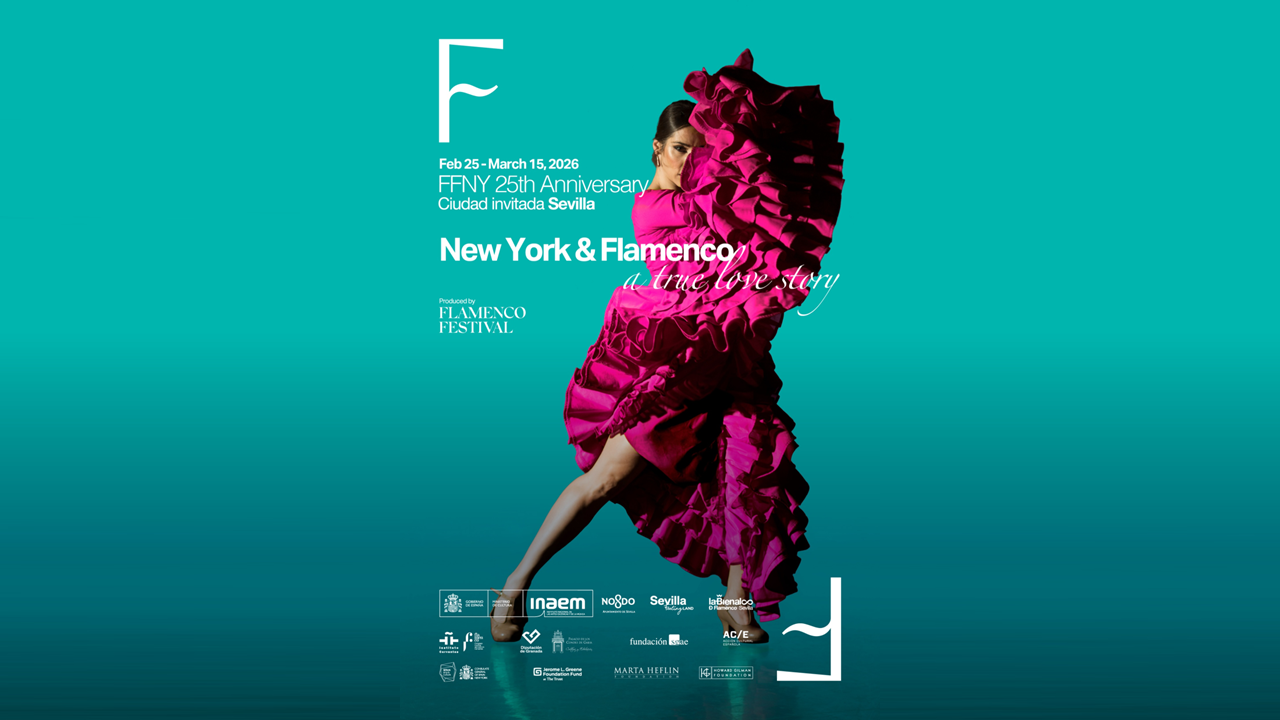
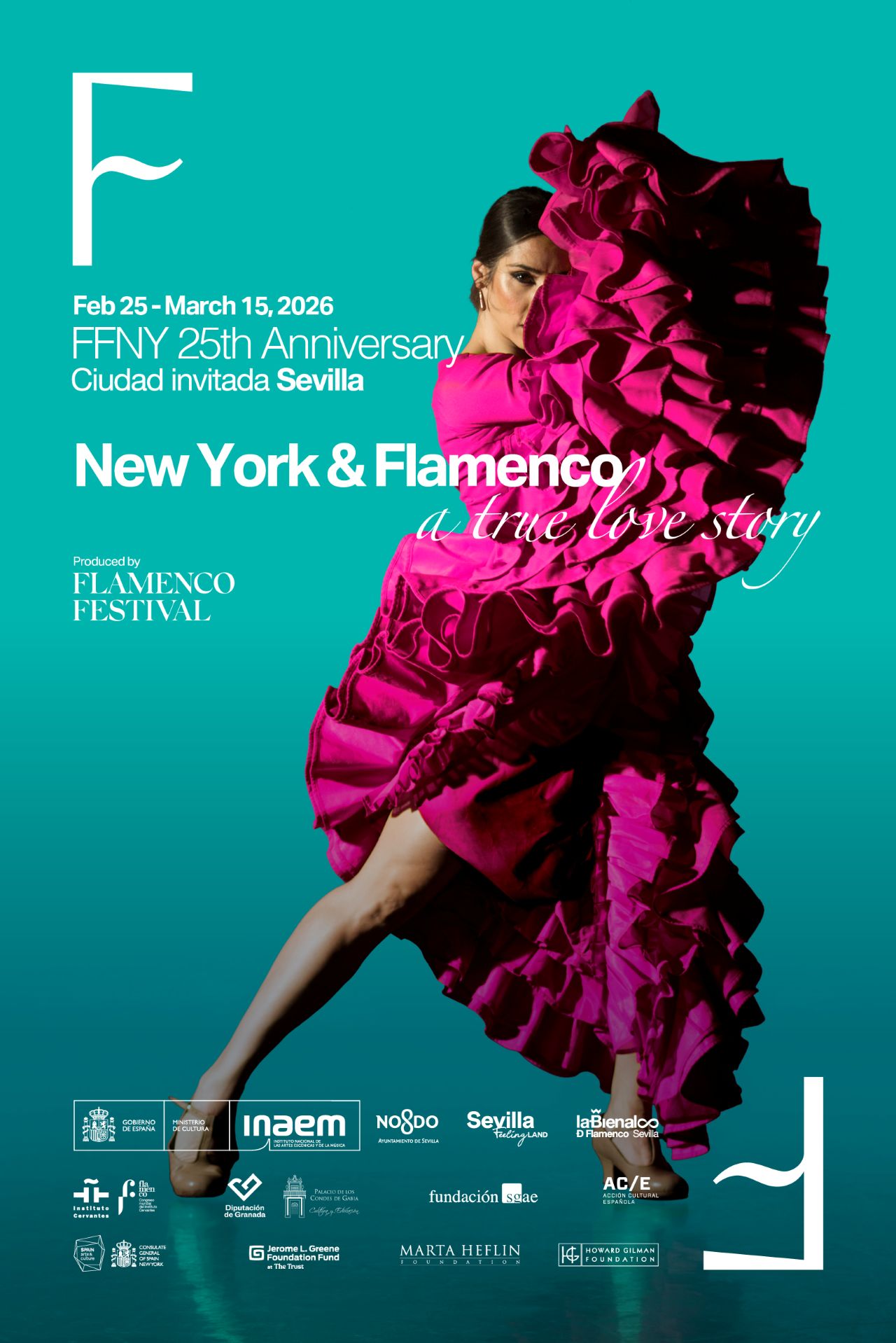
New York doesn’t merely host flamenco—it challenges it, amplifies it, and ultimately reshapes the way it is heard, seen, and remembered. In 2026, Flamenco Festival New York reaches a milestone that is both symbolic and deeply cultural: its 25th anniversary, framed by a theme that reads like a confession and a statement of intent at once—“A True Love Story.” The anniversary edition runs from February 25 to March 15, 2026, gathering more than 180 artists from 16 companies, with a total of 40 performances across New York City and a multi-city extension that includes Miami, Tampa, Chicago, and Boston.
Those numbers are impressive, but what truly defines this anniversary is not scale. It’s the festival’s architecture: the way it moves between grand theatres and intimate rooms, between collective celebrations and radical personal statements, between the stage and the city’s cultural institutions. It’s an edition that treats flamenco not as a “special event” but as a living artistic language—one that belongs in major performance venues, yes, but also in libraries, museums, and academic spaces where history is revisited and ideas are tested.
This is where the 25th anniversary becomes more than a birthday. It becomes a story that connects the flamenco of yesterday with the flamenco of tomorrow—while placing New York at the center of that bridge.
The anniversary theme: why “A True Love Story” is more than a slogan
“A True Love Story” is not presented as a decorative tagline. It is a curatorial key. The festival explicitly frames its 25 years as a relationship built over time—between an art form rooted in Andalusian tradition and a city famous for reinvention, hybridity, and cultural risk.
This framing matters because flamenco’s global history is not simply a timeline of tours and international success. It is a history of encounters: with audiences, with new venues, with other art forms, and with new ways of being seen. Few cities have functioned as such a powerful mirror and amplifier as New York. That is why the festival’s anniversary narrative invokes figures whose presence in the city helped define flamenco’s international imagination: Carmencita, La Argentinita, Carmen Amaya, Sabicas, Vicente Escudero, Mario Escudero, and Paco de Lucía, among others.
The point is not nostalgia. The point is continuity. The festival suggests that these artists did not simply pass through New York—they were transformed by it, and in turn transformed the city’s relationship with flamenco. In 2026, the participating artists are invited to pay tribute “from within their own scenic language,” meaning: not by imitation, but by creative dialogue. That is one of the most intelligent ways to commemorate an anniversary—by proving that memory can be active, contemporary, and artistically productive.
Dates, scale, and the festival map: New York at the center, a national tour around it
The anniversary edition runs from Feb 25 to Mar 15, 2026, and it is structured as a full cultural season, not a weekend burst. The festival’s figures tell the story of a major international event:
-
180+ participating artists
-
16 companies
-
40 performances
-
New York City as the core, plus Miami, Tampa, Chicago, Boston
In New York, the festival is presented across 20 spaces, combining long-time festival homes with major cultural institutions. Regular venues include landmark stages such as New York City Center, Jazz at Lincoln Center, Joe’s Pub, and Roulette. The program also expands into spaces that place flamenco in broader cultural dialogue: Baryshnikov Arts, the Guggenheim, the Metropolitan Museum of Art, and the New York Public Library.
This matters because the venue list is part of the curatorial idea. When flamenco appears in museums and libraries, it stops being framed as “just performance” and begins to be understood as cultural history, creative research, and living heritage—something that belongs in the city’s most symbolic rooms.
Seville as the guest city: a symbolic anchor with contemporary weight
For the 2026 anniversary, Seville is named the guest city. In practice, this is more than a nod to tradition. Seville is simultaneously a cradle of flamenco lineage and a generator of contemporary artistic practice—an ecosystem where classic codes coexist with new dramaturgies of dance, singing, and guitar.
In an edition centered on a love story between flamenco and New York, Seville operates as an anchor point: it reminds the audience that flamenco’s global travel does not erase origin. Instead, origin becomes a source of renewal. The guest-city framing adds an implicit triangle to the festival narrative:
-
Root (Seville / Andalusia)
-
Encounter (New York / cultural crossroads)
-
Future (today’s artists / new languages)
The result is an anniversary that feels grounded and open at the same time.
MWE overhead
The lineup as a conversation: major names, multiple aesthetics, one narrative
The festival’s anniversary lineup is designed to represent range and depth. It includes internationally renowned figures and artists associated with today’s most vital directions in flamenco. Among the names highlighted: Sara Baras, Eva Yerbabuena, Manuel Liñán, Andrés Marín, Olga Pericet, Rocío Márquez, Ángeles Toledano, Rosario “La Tremendita,” Dani de Morón, Gerardo Núñez, and Antonio Rey, among many others.
But the more useful way to read this lineup is not simply as a list of “who’s coming.” It is a program of contrasts and bridges:
-
Grand theatre celebrations that create a shared, high-energy public ritual
-
Author-driven works that place flamenco in conversation with contemporary staging and concept
-
Guitar-forward experiences that elevate the instrument as both memory and invention
-
Context-building events (talks, lecture-performances) that turn attendance into understanding
That combination is precisely what a 25th anniversary should do: it should feel like a summary of the festival’s identity and a manifesto of its future.
Opening night: Rocío Márquez and Himno Vertical — flamenco as contemporary ritual
The festival opens on February 25 with Rocío Márquez presenting Himno Vertical at the CUNY Graduate Center, accompanied by guitarist Pedro Rojas-Ogáyar. The work is described as artistically and conceptually profound—taking the form of a contemporary requiem. Importantly, it is framed not as a gesture limited to farewell, but as a ceremony that also celebrates origin, passage, and transformation.
Why this opening is a statement
Anniversary editions often open with spectacle: fireworks, galas, “big nights.” This one opens with listening—with an inward-facing work that treats flamenco as a space for reflection and sonic architecture. That choice says something essential about the festival’s self-image:
-
Flamenco is not only celebration; it is thought, ritual, and depth.
-
Singing can carry conceptual structure without losing emotional truth.
-
A 25th anniversary can be commemorated by expanding language, not just replaying greatest hits.
This opening sets the tone for an edition that aims to be as meaningful as it is impressive.
From inner intensity to collective impact: the Gala Flamenca at New York City Center
If the opening night proposes flamenco as ritual, the next pillar reveals it as communal celebration: the Gala Flamenca takes over the iconic New York City Center on Feb 26, Feb 28, and Mar 1.
The gala explicitly recalls the spirit of Flamenco Puro—the legendary show that conquered Broadway in 1986 and became a milestone in flamenco’s New York history, associated with names such as Farruco, El Guito, and Manuela Carrasco. For the 25th anniversary, the gala brings together a particularly high-profile group of contemporary artists: Eva Yerbabuena, Manuel Liñán, El Farru, and Juan Tomás de la Molía.
Why the Gala matters in this edition
The gala functions as a public “center point.” In a program with multiple aesthetics and formats, it provides a shared experience that is both accessible and artistically rich.
It also offers a powerful anniversary symbolism:
-
Broadway memory becomes present tense, not a museum piece.
-
The festival honors legacy while showcasing today’s most significant dance voices.
-
The audience experiences flamenco as an event of collective rhythm—body, compás, and shared attention.
Estévez/Paños y Compañía: La Confluencia — mestizaje as origin, not trend
After the collective celebration of the gala, the festival moves into contemporary choreographic territory with Estévez/Paños y Compañía (National Dance Award 2019, Creation). On Friday, Feb 27, they present La Confluencia at New York City Center.
The work is inspired by figures including Vicente Escudero, Mario Maya, and Carmencita and places at its center a fundamental idea: flamenco is born from mestizo origins—from the meeting of cultures. The piece claims that origin as an ongoing creative truth: a living space of cross-pollination, memory, and transformation.
Why this belongs in a 25th anniversary
In an edition devoted to a love story between flamenco and New York, a piece focused on cultural confluence is perfectly placed. New York is a city defined by encounter. Flamenco is an art defined by historical crossing. The work’s thesis becomes a shared language between city and art form—one of the clearest ways the festival makes its theme tangible.
Landscape + Silencios: Carmen Amaya, John Cage, and New York as a meeting point
Estévez/Paños y Compañía return on March 3, this time at NYU Espacio de Culturas, joined by dancer Yoel Vargas (making his New York debut), presenting the double bill Landscape + Silencios—a program that pays tribute to Carmen Amaya, John Cage, and Vicente Escudero.
In Landscape—a suite for dance and percussion—Yoel Vargas draws power from Carmen Amaya’s zapateado and from John Cage’s percussion compositions, imagining an encounter between the Catalan dancer and the American composer in 1940s New York. Silencios emerges as a direct confrontation between Estévez and Paños in their purest essence, without other musicians or dancers—exploring a connection between two bodies, two styles, and two lived histories.
The deeper meaning of this program
This double bill embodies the festival’s core idea: New York as a place where artistic universes intersect in ways that become creatively inevitable rather than conceptually forced. Carmen Amaya and John Cage are not paired for novelty. They are paired because New York makes such pairings plausible—and because flamenco’s modern identity has long been shaped by dialogue with broader artistic currents.
Joe’s Pub: guitar “stripped bare” and the power of intimacy
Not all festival identity is built in grand theatres. Flamenco Festival New York has long been defined by its ability to breathe in smaller spaces—where proximity changes perception, where a note hangs longer, where silence has weight.
At Joe’s Pub at The Public Theatre, the guitar opens the program through José Fermín Fernández, recognized in 2019 with the Bordón Minero prize and described as part of a new generation of guitarists balancing deep respect for tradition with a personal voice. On Friday, Feb 27, he presents Guitarra desnuda (“Naked Guitar”)—an intimate and essential journey through flamenco guitar, stripped of artifice, where each note and nuance is revealed with clarity.
The next day (the press release describes it as “the following day”), the same stage hosts Irene Morales, also making her New York debut, presenting RAW—a bold work developed in the context of the In Progress creative residencies. The piece places flamenco in intense dialogue between tradition and contemporaneity, and includes a special tribute to Sabicas, honoring the legendary guitarist through dance to his iconic “Zapateado.”
Why intimacy is crucial in anniversary years
Anniversaries can easily become oversized. Intimate rooms are where truth remains unmistakable. They remind audiences that flamenco’s power does not depend on scale; it depends on presence—on the exposed pulse of rhythm, the nakedness of sound, the living relationship between performer and listener.
Flamenco beyond the stage: scholarship, cultural history, and the city as archive
One of the festival’s defining strengths is its commitment to context. Flamenco Festival New York has a habit of expanding flamenco beyond performance into spaces of reflection and cultural memory—making the city itself part of the program.
On the first day (Feb 25) at the CUNY Graduate Center, a talk titled “Electric Bohemian: Flamenco and the Arts in Greenwich Village (1950s–1970s)” brings together flamenco specialist K. Meira Goldberg and cultural historian Elijah Wald. The talk explores the historical and artistic connections of flamenco within intercultural contexts, focusing on how Greenwich Village became a hub of artistic experimentation—home to Beat culture, 1960s counterculture, and avant-garde movements. It also examines how alternative and queer cultures coexisted with a flourishing flamenco scene growing alongside the city’s famous folk scene.
In a second major context event, the festival enters one of New York’s most emblematic cultural institutions: the New York Public Library, co-organized with the Consulate of Spain in New York. On Saturday, Feb 28, writer, professor, and PhD in Spanish Literature José Javier León leads “La Argentinita in New York, New York in La Argentinita”—a lecture-concert celebrating the legacy of the iconic singer and dancer Encarnación López Júlvez (“La Argentinita”), illustrated with live performances by festival artists such as Rocío Márquez, Rafael Estévez, and Irene Morales, among others.
Why these events elevate the festival
These activities do something rare: they turn attendance into cultural understanding. They invite audiences to connect a performance to a history, a style to a city, a name to a network of collaborations and artistic decisions. For an international festival, this is not a side feature—it is part of what makes the event a reference point rather than a simple showcase.
“This is only the beginning”: the wider anniversary season through March 15
The press release emphasizes that the early program is only the start of the 25th anniversary edition, continuing through March 15 with major appearances and events such as:
-
Dani de Morón at Jazz at Lincoln Center
-
Fiesta Flamenca at Baryshnikov Arts, featuring dancers Juan Tomás de la Molía, Alberto Sellés, Raquel Heredia “La Repompa”, and Mara Rey
-
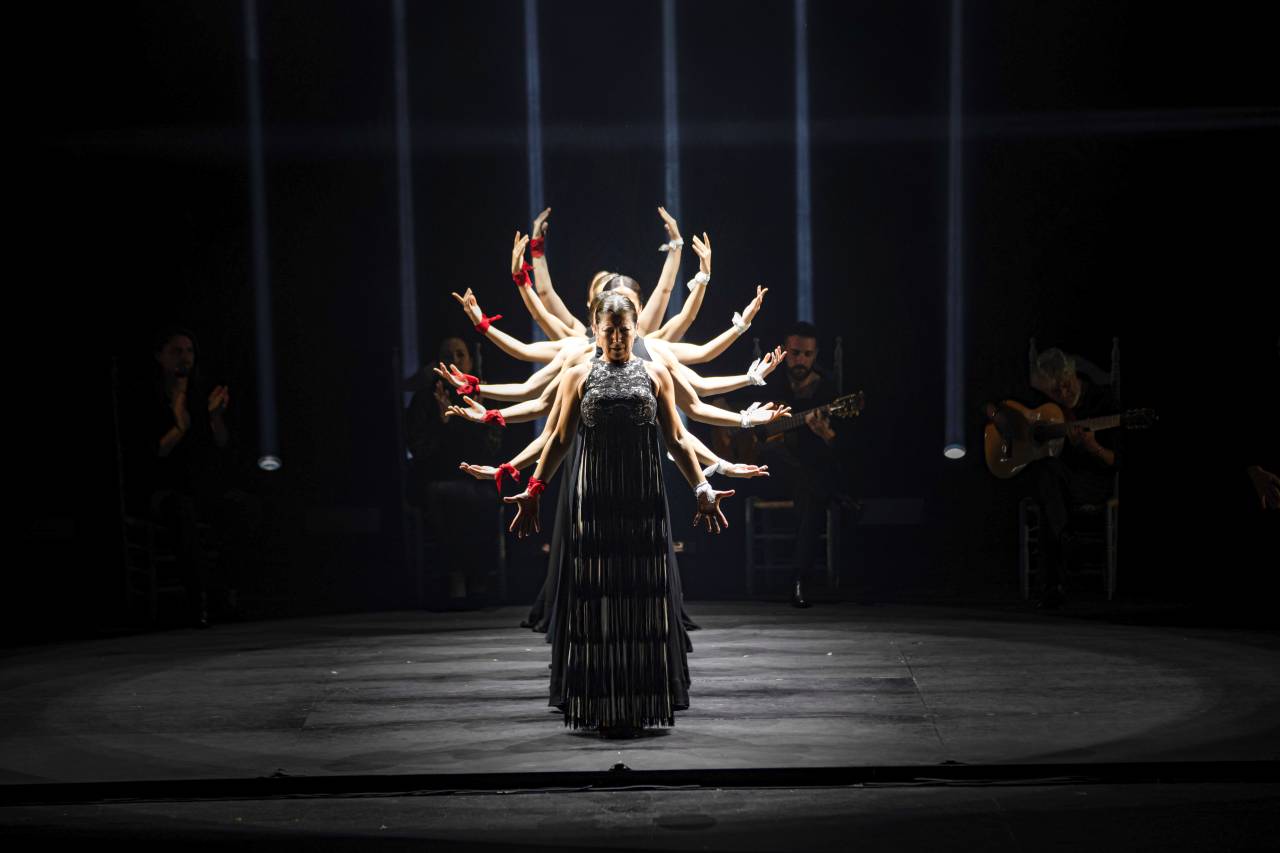
Performances of Vuela by Sara Baras at New York City Center
-
The debut of Ángeles Toledano
-
Tránsito by Rosario “La Tremendita”
-
And many additional proposals across the festival’s New York and touring footprint
Together, these elements reinforce the anniversary’s identity: a program that is celebratory but not superficial, historically aware but not trapped in nostalgia, and expansive without losing a sense of curatorial coherence.
Vuela Sara Baras © Sofia Wittert
A U.S. expansion: Miami, Tampa, Chicago, Boston — flamenco as a national cultural circuit
While New York remains the festival’s heart, the 25th edition extends its reach beyond the city in a way that signals growth and national projection. The press release frames these touring stops as curated opportunities for local audiences to experience selected highlights of the festival, reaffirming the national scope of contemporary flamenco.
Miami
Miami’s festival programming extends into two notable spaces. Sara Baras presents Vuela with two performances on Feb 28 and Mar 1 at the Knight Concert Hall (Arsht Center). Meanwhile, the Miami Beach Bandshell hosts Ángeles Toledano on Mar 5 with En concierto—a program described as combining tradition and innovation, showcasing her powerful voice and renewing approach.
Tampa
In Tampa, the Straz Center features Sara Baras and Vuela on Mar 3.
Chicago
In Chicago, the Instituto Cervantes organizes two shows: Irene Morales presents RAW on Mar 1, and Dani de Morón presents Carte blanche on Mar 6.
Boston
In Boston, the Berklee Performing Arts Center hosts the Tribute to Sabicas on Mar 13—a program that then travels to New York the following day. The tribute features Gerardo Núñez, Antonio Rey, Álvaro Martinete, and Olga Pericet, honoring the legendary flamenco guitarist Sabicas.
This touring expansion matters because it shifts the festival from being a New York “moment” to a broader U.S. cultural circuit. It reinforces flamenco’s status not as an occasional import, but as a growing presence in major American cultural calendars.
Conclusion: an anniversary that feels like a city, a memory, and a future
Flamenco Festival New York 2026 is not simply celebrating 25 years. It is renewing a relationship—and doing it in a way that feels consistent with both flamenco’s essence and New York’s identity.
The festival’s anniversary narrative insists on something powerful: that flamenco’s international history is shaped by encounter, by the ways cities hear it and change it, by the artists who carried it across oceans and the audiences who received it as something urgent and alive. From Rocío Márquez’s ritual intensity to the City Center gala’s communal force; from mestizaje as creative origin to unexpected artistic dialogues; from the intimacy of guitar-forward nights to the depth of scholarly and cultural programming—this edition argues that flamenco belongs everywhere culture is taken seriously.
If “love story” is the theme, it is because flamenco at its best requires what love requires: presence, risk, and devotion. New York understands that. And this 25th anniversary is the festival’s way of saying it out loud.
Dates at the end — Selected schedule
New York City
-
Wed, Feb 25, 2026 — Rocío Márquez: Himno Vertical (CUNY Graduate Center)
-
Wed, Feb 25, 2026 — Talk: “Electric Bohemian: Flamenco and the Arts in Greenwich Village (1950s–1970s)” (CUNY Graduate Center)
-
Thu, Feb 26, 2026 — Gala Flamenca (New York City Center)
-
Fri, Feb 27, 2026 — Estévez/Paños y Compañía: La Confluencia (New York City Center)
-
Fri, Feb 27, 2026 — José Fermín Fernández: Guitarra desnuda (Joe’s Pub at The Public Theatre)
-
Sat, Feb 28, 2026 — Gala Flamenca (New York City Center)
-
Sat, Feb 28, 2026 — Lecture-concert: “La Argentinita in New York, New York in La Argentinita” (New York Public Library)
-
Sat, Feb 28, 2026 — Irene Morales: RAW (Joe’s Pub) (date inferred from “the following day” after Feb 27 in the press release)
-
Sun, Mar 1, 2026 — Gala Flamenca (New York City Center)
-
Tue, Mar 3, 2026 — Estévez/Paños y Compañía + Yoel Vargas: Landscape + Silencios (NYU Espacio de Culturas)
-
Sat, Mar 14, 2026 — Tribute to Sabicas (New York) (the press release states it arrives one day after Boston on Mar 13)
Miami
-
Sat, Feb 28, 2026 — Sara Baras: Vuela (Knight Concert Hall, Arsht Center)
-
Sun, Mar 1, 2026 — Sara Baras: Vuela (Knight Concert Hall, Arsht Center)
-
Thu, Mar 5, 2026 — Ángeles Toledano: En concierto (Miami Beach Bandshell)
Tampa
-
Tue, Mar 3, 2026 — Sara Baras: Vuela (Straz Center)
Chicago
-
Sun, Mar 1, 2026 — Irene Morales: RAW (Instituto Cervantes)
-
Fri, Mar 6, 2026 — Dani de Morón: Carte blanche (Instituto Cervantes)
Boston
-
Fri, Mar 13, 2026 — Tribute to Sabicas (Berklee Performing Arts Center)
Flamenco Festival New York website
Key Highlights of the Great Flamenco Festival in New York
1) When is Flamenco Festival New York 2026, and how long does it run?
Flamenco Festival New York 2026 runs from February 25 to March 15, 2026, which makes it feel less like a short event and more like a full cultural season. That timeframe matters because the festival is designed in layers: major theatre nights sit alongside intimate club-style performances, and those are complemented by contextual programming in cultural institutions. In other words, the “duration” is not only about calendar days—it’s about how the experience unfolds across different spaces and formats. The 25th anniversary framing also shapes the rhythm of the edition. Rather than focusing only on headline shows, the festival builds a narrative around memory, artistic evolution, and New York’s historic relationship with flamenco. For attendees, this means you can plan the festival in a meaningful way: a large-scale gala for communal energy, an author-driven work for contemporary perspective, and at least one talk or lecture-concert to deepen your understanding of the festival’s story. The longer run makes it easier to curate your own route through the program—whether you’re visiting New York for a few days or following select events across different U.S. cities.
2) Who are the key artists, and how should I choose what to see if I don’t know the lineup?
The anniversary edition highlights major names across flamenco’s core disciplines—dance, singing, and guitar—such as Sara Baras, Eva Yerbabuena, Manuel Liñán, Olga Pericet, Andrés Marín, Rocío Márquez, Ángeles Toledano, Rosario “La Tremendita,” Dani de Morón, Gerardo Núñez, and Antonio Rey, among others. If you don’t know everyone on the bill, the best approach is to choose by the kind of experience you want, not by name recognition alone. If you want a high-impact, classic “big night” feeling, the Gala Flamenca in a major theatre is an ideal entry point, because it concentrates top-level dance in a celebratory format. If you’re drawn to flamenco as contemporary art and concept, the opening with Rocío Márquez and Himno Vertical offers a different gateway: intimate, ritual-like, and rooted in the expressive power of the voice. If your curiosity leans toward choreography and cross-genre dialogue, works like Estévez/Paños y Compañía provide a path into flamenco as research and reinvention. And if you love sound and detail, smaller venues and guitar-led nights can deliver the most unforgettable sense of proximity and presence. The lineup is intentionally diverse; the festival invites you to enter flamenco through whatever door feels most natural.
3) Why does the 25th anniversary emphasize New York’s connection to historical figures like La Argentinita or Sabicas?
Because the festival is telling a specific story: flamenco and New York have shaped each other over time. In an anniversary year, the goal is not just to present today’s leading artists, but to situate them within a broader cultural lineage. Referencing figures such as La Argentinita and Sabicas signals that New York has long been a stage where flamenco’s international identity has been negotiated—through performance, migration, audience encounter, and artistic exchange. La Argentinita represents an early kind of modernity: a performer who could carry tradition while reimagining it for new contexts. Sabicas, meanwhile, embodies the guitar as both heritage and innovation—an instrument that travels, remembers, and continues to write flamenco’s story in new places. By weaving these references into tributes and contextual events, the festival turns history into something active: not a museum exhibit, but a living framework that helps audiences understand why flamenco in New York feels uniquely charged. It’s a way of saying: this relationship has depth, and the present edition is part of that continuing arc.
4) What does it mean that the festival goes beyond theatres into libraries, museums, and academic spaces?
It means Flamenco Festival New York is positioning flamenco as a full cultural language, not just a stage genre. When programming expands into libraries, museums, and academic environments, it signals that flamenco belongs in spaces where society preserves memory and produces knowledge. These events create context: they help audiences connect performances to cultural history, artistic movements, and the city’s own creative ecosystems. In the 2026 anniversary edition, talks and lecture-concerts explore how flamenco intersected with New York’s cultural life—such as Greenwich Village’s bohemian and avant-garde scenes—and how figures like La Argentinita left a meaningful imprint in the city. For viewers, the value is practical and emotional: the more you understand the story behind an art form, the richer the live experience becomes. A theatre performance gives you intensity; a contextual program gives you depth. Together, they turn festival attendance into something closer to cultural immersion.
5) What is the significance of the touring expansion to Miami, Tampa, Chicago, and Boston?
The multi-city expansion reflects flamenco’s growing presence in the United States as part of a broader cultural circuit. While New York remains the festival’s symbolic and curatorial center, bringing select programming to Miami, Tampa, Chicago, and Boston extends the anniversary beyond one city and makes it accessible to wider audiences. Strategically, this signals maturity: a festival capable of building partnerships, reaching multiple publics, and sustaining flamenco as a recurring cultural event rather than a one-off showcase. Artistically, it also clarifies the festival’s identity—because touring stops tend to feature key works that represent the edition’s core themes: major artists, new voices, tributes to heritage, and contemporary creation. For audiences outside New York, the expansion offers a chance to experience the anniversary spirit locally. For the festival, it strengthens the “love story” premise: not only between flamenco and New York, but between flamenco and the broader American cultural landscape it continues to win over—city by city, stage by stage.